

Tired is not a personality.
NAD+, glutathione and B12. There is real biochemistry behind all of it and there is also a great deal of nonsense sold alongside it. This is what each one actually does at cell level, who it genuinely helps, and the honest list of who it does not.
Start with why, not with what.
The most useful thing in this entire guide is on this page, and it is free.
If you are exhausted every week, the correct first move is not to book something. It is to find out what is going on. Thyroid, iron, B12, vitamin D, blood sugar, sleep apnoea, perimenopause, depression, and simply not sleeping enough are all extremely common and all produce the exact same complaint: I am tired all the time and I do not know why.
Several of those need a doctor. Some need a blood test and nothing else. None of them are fixed by a bag of vitamins, and anyone who sells you one without asking the question is not looking after you.
What Rio Glow actually does about this
There is a metabolic assessment on the menu for exactly this reason — a proper look at what is happening before anything gets recommended. It is the least glamorous thing on the price list and it is frequently the highest-value one, because the answer is often that you do not need the treatment you came in asking about.
With that said — the biochemistry underneath these treatments is genuine and worth understanding. Here is what each one is.
The rest of the guide is free.
Eleven pages: why an infusion is different to a tablet, what NAD+ does inside a cell, the glutathione cycle, and who is genuinely B12 deficient.
Open the guideThe mechanism behind all of it
Why a bag and not a tablet.
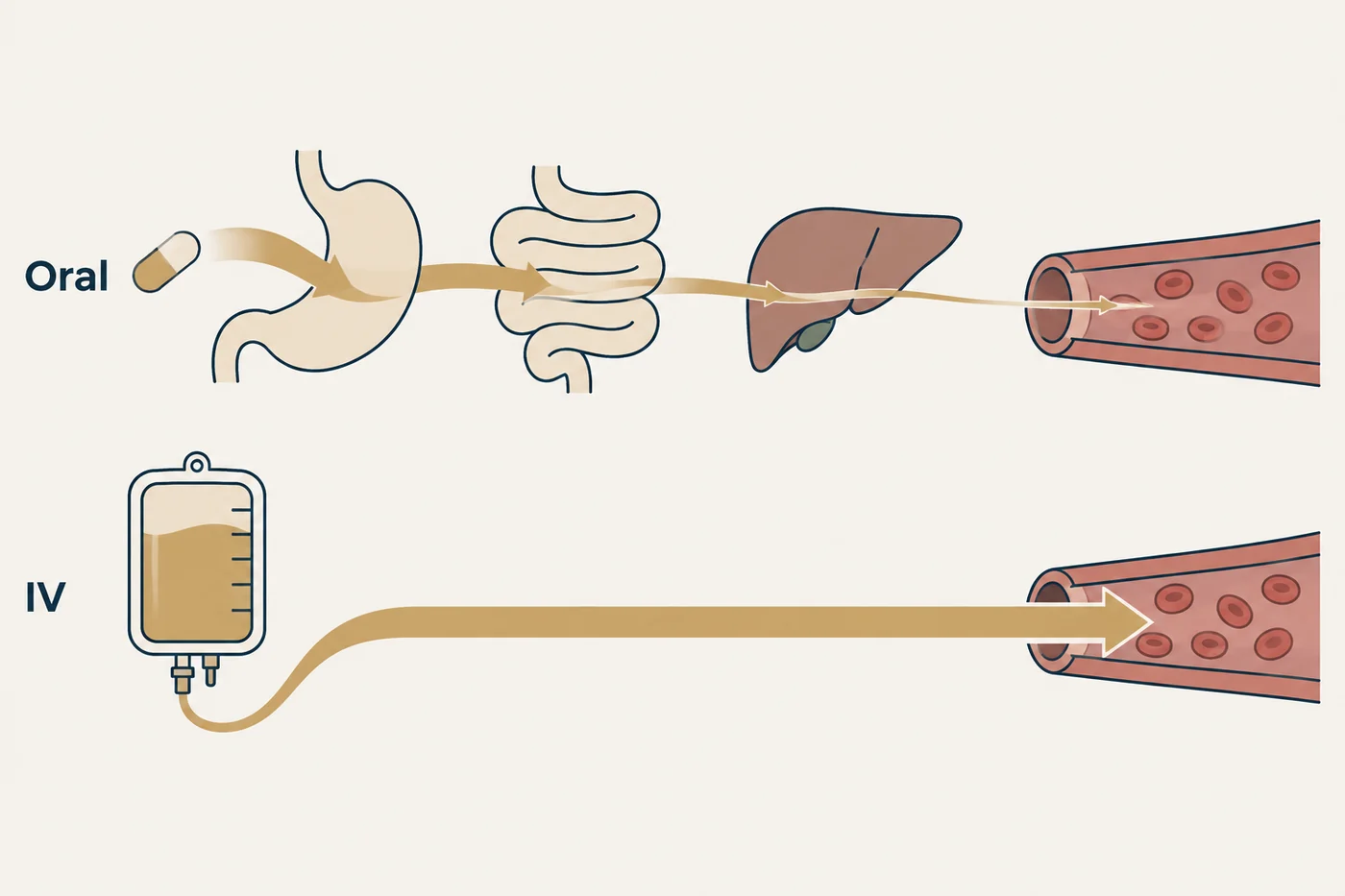
Everything you swallow runs an obstacle course. It has to survive stomach acid, then cross the wall of your intestine — which is selective, and for some nutrients uses transporters that saturate — and then it goes straight to the liver before it reaches the rest of you. That last step is called first-pass metabolism, and for certain molecules it removes most of the dose before it ever gets anywhere useful.
Vitamin C is the textbook example: gut absorption is actively capped, so beyond a certain oral dose you are mostly producing expensive urine. Glutathione taken by mouth is another — it is a small protein and it is largely taken apart in digestion.
An infusion bypasses every one of those steps. Whatever is in the bag reaches your bloodstream, at concentrations that are simply not achievable orally. That is the whole mechanical argument, and it is real.
The honest counterweight
Higher blood levels are not automatically better outcomes. For plenty of nutrients your body simply excretes the excess. The argument for IV therapy is strongest where oral absorption is genuinely limiting, and weakest where it is not — and a good provider will tell you which is which rather than putting everything in one bag.
Chapter one
NAD+, and why it is not a vitamin drip.
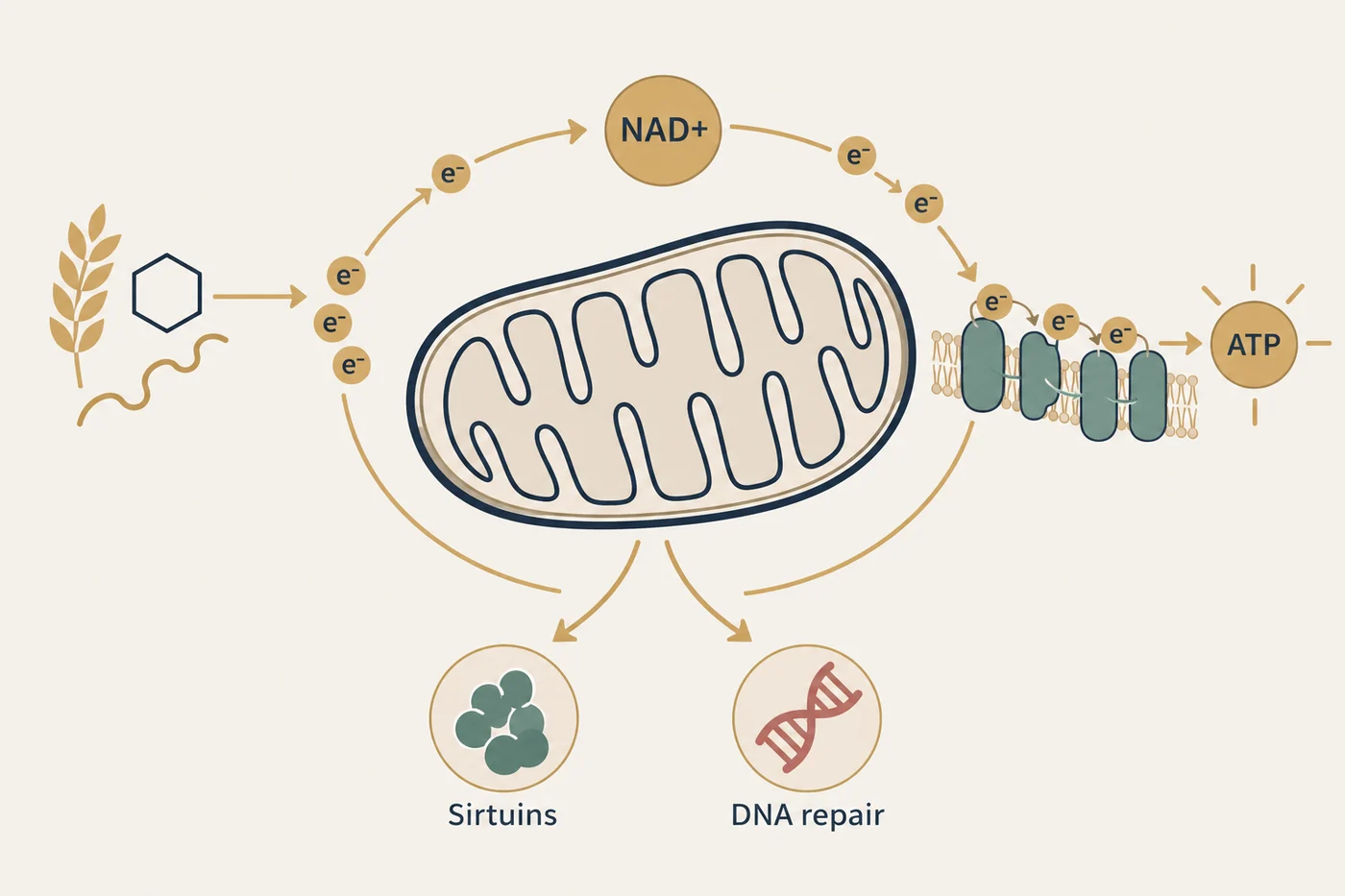
NAD+ — nicotinamide adenine dinucleotide — is a coenzyme present in every cell you have, and it does one fundamental job: it carries electrons.
That sounds abstract until you realise that is what energy production is. Breaking down glucose and fat to make ATP is a series of reactions that strip electrons from fuel molecules and pass them down a chain inside your mitochondria. NAD+ is the carrier that does the passing. Without enough of it, the chain does not run at full speed — and every process downstream of it slows too.
It is also the substrate for two families of enzymes that get a great deal of research attention: sirtuins, involved in cellular stress response, and PARPs, involved in DNA repair. Both of those consume NAD+ when they work. Which means damage and repair are, quite literally, spending the same currency that powers you.
NAD+ levels decline measurably with age. That single fact is the entire basis for the interest in restoring it, and it is why NAD+ occupies a different category to a vitamin infusion: you are not topping up a nutrient you might be short of, you are restoring a cofactor that everyone is progressively short of.
Read this before your first one
NAD+ has to be infused slowly. Pushed too fast it reliably produces chest tightness, flushing, cramping and a wave of nausea. It is not dangerous and it stops within a minute of slowing the drip — but it is genuinely unpleasant, and it is entirely a rate problem.
Say something the moment you feel it. There is no prize for enduring it, and slowing down does not reduce the dose you receive — only how quickly you receive it. This is also why a bigger bag takes real time and cannot be squeezed into a lunch break.
Rio Glow runs it across several strengths — 250, 500, 750 and 1000 mg — and most people start low and work up rather than beginning at the top. There is a take-home form and a nasal spray for people already established on it, which exist because the infusion is a real time commitment.
Chapter two
Glutathione, the one your liver is already using.
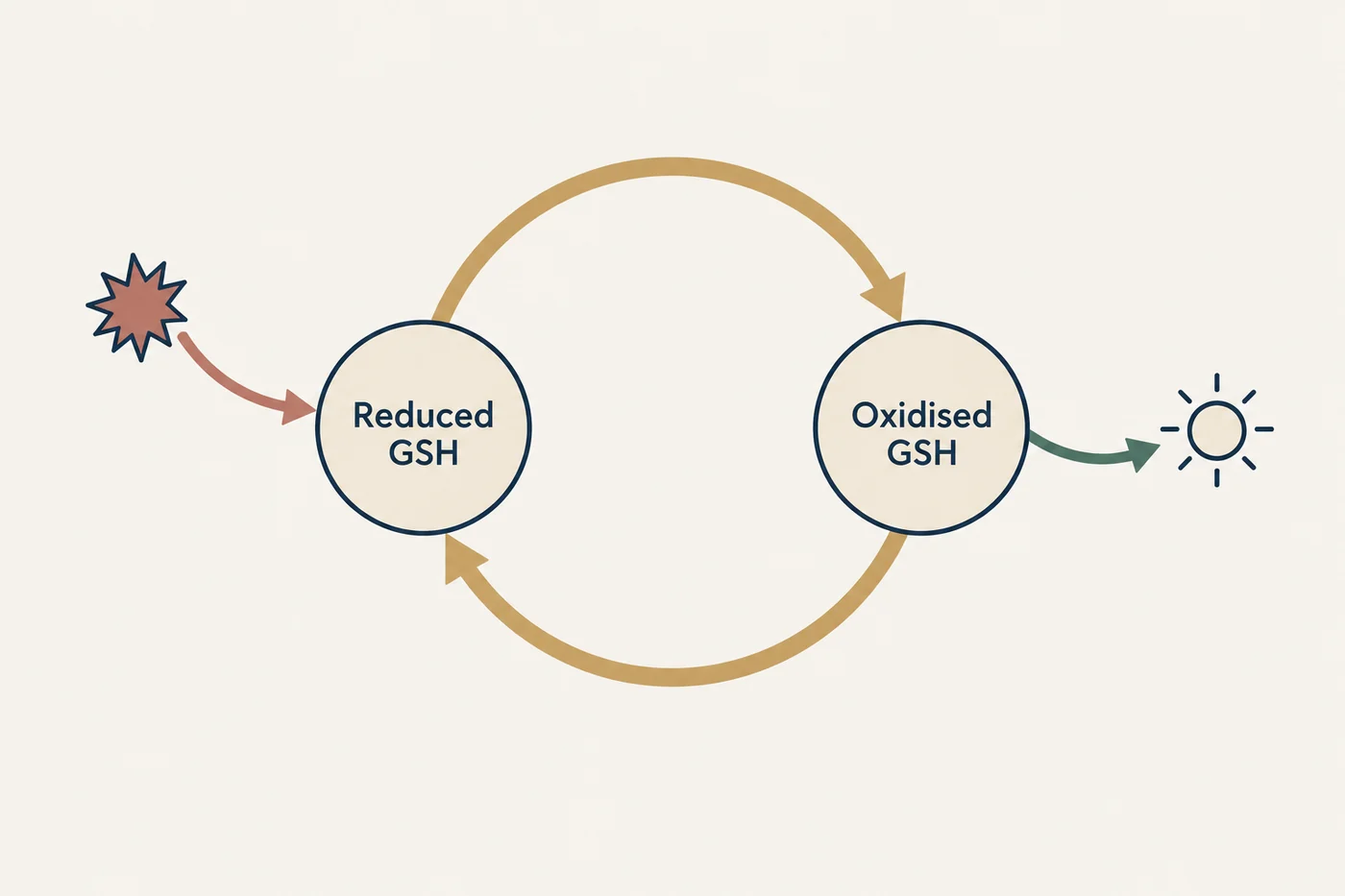
Glutathione is a tripeptide — three amino acids, glutamate, cysteine and glycine, joined together. Your cells make it themselves, continuously, and it is generally described as the body's master antioxidant, which for once is not marketing.
Its job is to neutralise reactive oxygen species — the unstable molecules produced as a by-product of ordinary metabolism — by donating an electron and taking the hit itself. It also plays a central role in how your liver processes and clears things, which is why liver cells carry more of it than almost any other tissue.
Levels fall with age, and they fall faster with alcohol, illness, poor sleep, sun exposure and chronic stress. Which is a fairly precise description of the week most people are having when they book a drip.
At Rio Glow it appears in two ways: as an add-in to the Rio Glow drips, and as its own infusion for people who specifically want it. The skin-brightening reputation is why most people ask for it; the antioxidant and liver-support role is the reason it earns its place regardless.
Chapter three
B12, and the burner shot.
B12 — cobalamin — is not optional. It is required for building the myelin sheath around your nerves, for making red blood cells, and for one-carbon metabolism, the set of reactions your body uses to attach methyl groups to things. Methylation is involved in producing neurotransmitters, in regulating gene expression, and in clearing homocysteine.
Real deficiency produces fatigue, pins and needles, brain fog and low mood — and it is genuinely common in specific groups:
- Anyone on metformin long term. It interferes with B12 absorption. This is well established and frequently missed.
- Anyone on acid-reducing medication. Stomach acid is part of how B12 is liberated from food.
- Vegetarians and vegans. B12 is essentially absent from plant foods.
- Anyone who has had gastric surgery. The absorption pathway depends on a specific part of the stomach and gut.
- Older adults generally. Absorption efficiency declines with age.
If you are in one of those groups and you are exhausted, ask for it to be checked. That is a blood test, not a purchase.
What the "burner" actually is
The Rio Glow Burner is B12 combined with lipotropic compounds — methionine, inositol and choline, which is where the shorthand MIC comes from. These are involved in how the body handles and transports fat, and they have been used alongside B12 in injections for a long time.
It is popular because it takes five minutes, needs no chair, and is inexpensive enough to be a routine rather than an occasion. It is a support, not a weight-loss treatment on its own — if fat loss is the actual goal, the honest conversation is a medical weight management one.
Chapter four
The order to do this in.
- Get the boring things ruled out. Thyroid, iron, B12, vitamin D, blood sugar. If one of those is the answer, everything below becomes unnecessary.
- Fix sleep before you buy energy. Nothing on this menu competes with six good nights. If you snore heavily and wake unrefreshed, ask about sleep apnoea — that is a real medical thing with a real treatment.
- Then start simple. Hydration and a B12 shot are cheap, quick, and tell you a lot about how you respond before you commit to anything larger.
- Then the targeted work. NAD+ if the picture is cellular fatigue and fog. Glutathione if it is oxidative load, alcohol, skin.
- Then build a rhythm rather than chasing crises. The people who feel best are not the ones who book the biggest bag once — they are the ones doing something modest on a schedule.
The other half
Who should not have this.
- If you are pregnant or breastfeeding — almost everything in this guide waits, and that includes the ones that seem harmless.
- If you have kidney disease or heart failure — a litre of fluid is a meaningful load. This needs your physician's input first, not a form at a front desk.
- If you have a known G6PD deficiency — high-dose vitamin C is specifically a problem. Say so before anything is mixed.
- If you take medication for a chronic condition — bring the list. Interactions are the reason the intake form is long.
- If you are acutely unwell with a fever — call first. Sometimes the right answer is a doctor rather than a drip, and you should want a clinic that will say so.
Want it as a PDF?
Ask for a copy at your consultation.
Not sure where you land?
The drip quiz asks six questions about how your week has actually gone and points at one thing — including, sometimes, the cheapest thing on the menu.

Your glow up starts with a conversation
New clients start with a free 45-minute consultation with Tathiana.