

Fill it, or build it.
There are two entirely different businesses being run under the word "filler". One puts something into your face. The other convinces your face to make something itself. They cost similar money, they look nothing alike on a calendar, and almost nobody explains the difference before you are already holding a card.
What collagen actually is.
A scaffold, not a cream ingredient.
Collagen is the structural protein that makes up most of the dry weight of your skin. It is produced by cells called fibroblasts that live in the dermis, and it is what gives skin the ability to hold a shape, snap back, and reflect light evenly. Elastin lets it stretch. Collagen is what stops it staying stretched.
From roughly your mid-twenties, production falls a little every year, and existing collagen also becomes more disorganised. That is the actual mechanism of a face "deflating" — not weight, not gravity alone, but a scaffold thinning out underneath skin that stays the same size.
Which gives you exactly two options
Put something in to take up the space — that is filler, and it works today. Or get your fibroblasts to build more scaffold — that is everything else in this guide, and it works in months. Neither is better. They answer different questions.
The rest of this guide is the four building options at Rio Glow: what each one physically is, what it asks of your body, how long before you see anything, and how to choose between them without spending twice.
The rest of the guide is free.
Ten pages: the fill-versus-build chart, how poly-L-lactic acid actually works, why threads dissolve on purpose, the filler made from your own blood, and the honest month-by-month timeline for each.
Open the guideThe chart that explains everything
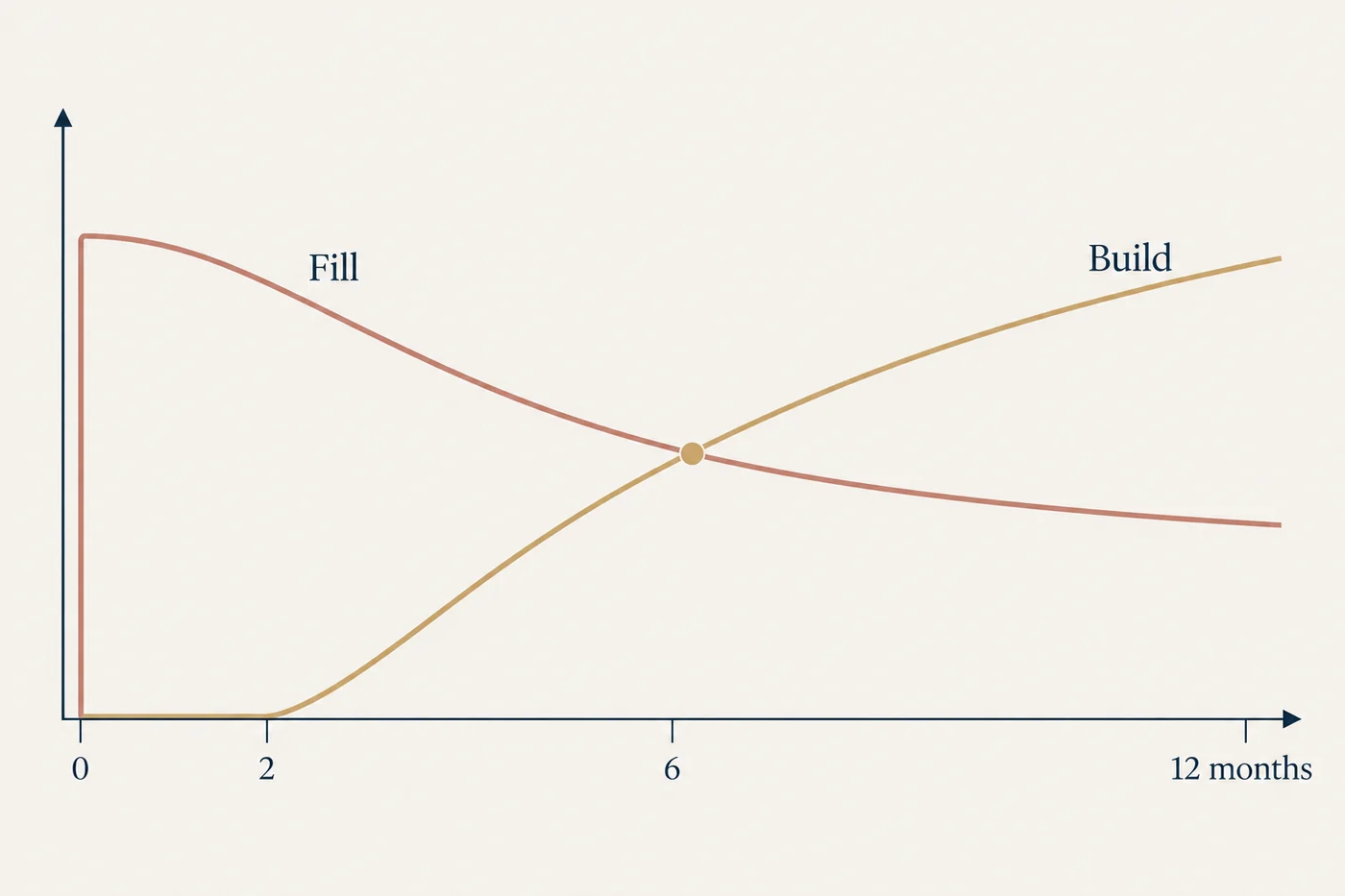
Two different shapes on a graph.
Filler is a step function. Nothing, then something, immediately — and then a slow decline as it metabolises. Collagen stimulation is a curve. Nothing for weeks, then a slow rise that keeps rising for months after you stopped paying for anything.
The question that decides it
"When do I need this to look good?" If the answer is measured in weeks, you want filler. If the answer is measured in seasons, building is nearly always the better spend — because what you build is yours, and it does not need topping up on the same schedule.
Option one
Sculptra, and why nothing happens for months.
Sculptra is poly-L-lactic acid — PLLA. It is a synthetic, biodegradable polymer that has been used in dissolvable surgical sutures for decades, which is a large part of why its safety profile is so well understood.
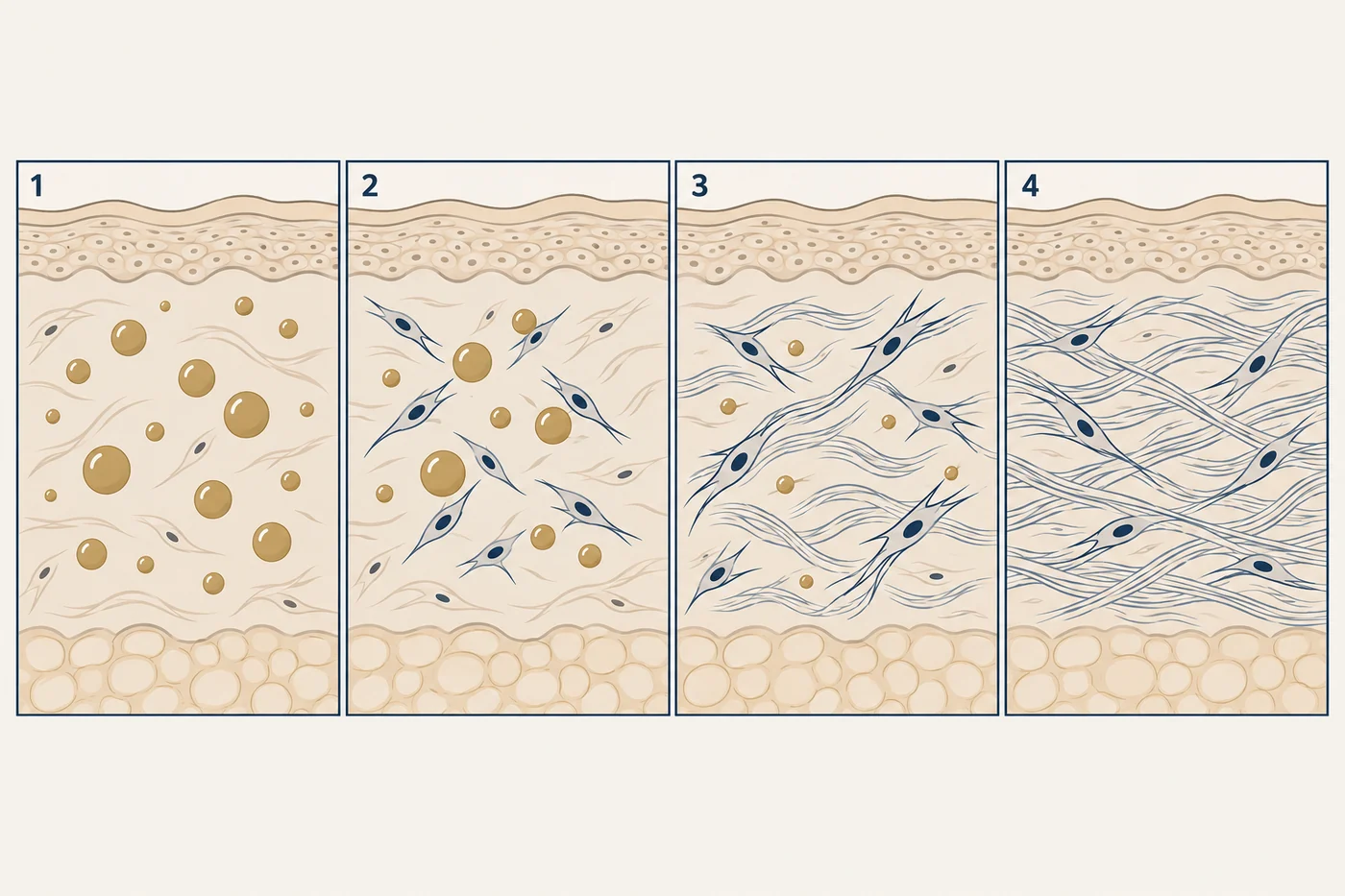
Here is the part people find genuinely surprising: Sculptra is not filling anything. The volume you see in the days after treatment is mostly the water it was reconstituted in, and it goes away. What is left behind are microparticles of PLLA sitting in the dermis, where your immune system notices them as foreign, mounts a low-grade, controlled response, and recruits fibroblasts to the area.
Those fibroblasts do what fibroblasts do. They lay down collagen. Over the following months the PLLA itself breaks down — into lactic acid, and eventually into carbon dioxide and water — and what remains is a scaffold you made.
Looks great. Ignore it.
That is the reconstitution fluid. It will settle and you will think it did not work. This is the single biggest reason people give up on Sculptra too early.
Back to baseline.
Genuinely nothing visible. Underneath, fibroblast activity is ramping up.
Session two, and then three.
Sculptra is a series, spaced weeks apart. Each session adds another round of signal.
The result arrives.
Gradually, which is exactly the point — nobody around you gets a day where you suddenly look different.
It holds for a long time.
You built structural protein. It behaves like structural protein.
The part that is on you
Sculptra comes with a massage protocol for the days after each session, and it is not optional decoration — it helps distribute the particles evenly. The people who skip it are the people who come back with a lumpy result and blame the product. Set an alarm on your phone. Genuinely.
Option two
PDO threads, and the two families nobody separates.
PDO is polydioxanone — another material borrowed straight from surgery, where it has been used as absorbable suture for decades. Placed under the skin it hydrolyses, meaning it is broken down by water in your tissue, and disappears over roughly four to six months.
While it is dissolving, it is doing the same thing PLLA does: provoking a controlled healing response along the length of the thread, and recruiting collagen to the exact line where it was placed. So even after the thread itself is gone, something remains.
The confusion is that two very different treatments share the name.
Smooth threads
Plain, fine, no barbs. They do not lift anything — they are placed in a grid or fan to stimulate collagen across an area. Think skin quality and fine crepiness, not repositioning. Placed in numbers, often ten or more in a session.
Lift threads
Barbed or moulded so they grip tissue. These do reposition, mechanically, in the moment — and then the collagen response builds along the line they created. Far fewer are used, and they cost considerably more each.
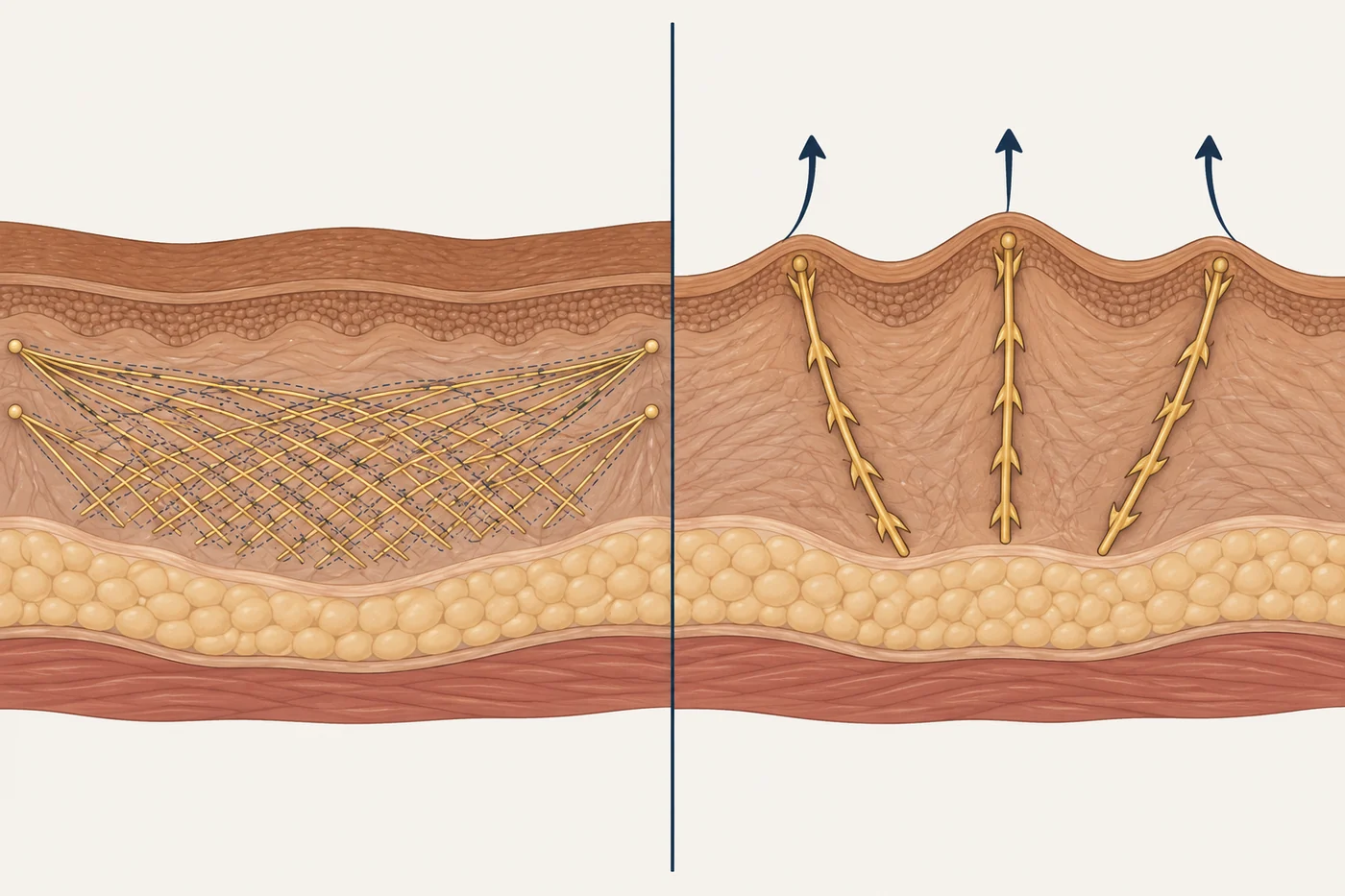
Rio Glow carries both, plus a mesh format used where a broader area needs support. Which one is right is a decision about whether your complaint is quality or position — and it is genuinely worth being asked that question rather than just being sold "a thread lift".
Setting expectations properly
A thread lift is not a facelift and any clinic implying it is has already told you something about itself. It is a real, visible repositioning with a real settling period — things can feel tight or slightly uneven for a couple of weeks, which is normal. Book it eight to twelve weeks before an event, never closer.
Option three
Cellenis DermaFiller, made from you.
This is the one that surprises people, because it is a filler and a stimulator at the same time, and the raw material is your own blood.
Blood is drawn and spun, which separates it into layers. Two of those layers get used. The first is platelet-rich plasma — platelets are packed with growth factors, the signalling molecules your body releases wherever it is repairing something. The second is platelet-poor plasma, which is rich in albumin, and this is the clever part: it is heated, which denatures and restructures those plasma proteins into something that resorbs far more slowly than plasma normally would.
Combine them and you get an injectable that provides immediate volume and releases platelet-derived growth factors gradually as it breaks down, typically over three to six months.
Why people choose it
It is autologous — there is nothing in it that did not come out of your arm twenty minutes earlier. For anyone hesitant about synthetic material in their face, or working in delicate areas like under the eyes where the tissue is thin and unforgiving, that matters a great deal.
The trade is that it does not last as long as a hyaluronic acid filler, and because it works partly by growth-factor signalling, the result builds rather than arriving whole. Book it six to eight weeks before anything you care about.
Option four
Energy, as a collagen treatment.
Radiofrequency microneedling belongs in this guide even though it is usually filed under "skin". Controlled thermal injury in the dermis triggers the same repair cascade — inflammation, then proliferation, then remodelling — and remodelling means new, better-organised collagen.
The difference is where it works. Injectable stimulators build in the specific place they were placed. Energy treats a whole area at once. Which is why they are frequently used together rather than being alternatives: Sculptra for structure in a defined region, RF microneedling for the overall quality of the skin sitting on top of it.
The full explanation of how Scarlet RF works — the twenty-five needles, the depth control, why the needles are not insulated — is in the laser guide.
Side by side
Choosing without spending twice.
| If you want… | Consider | See it by |
|---|---|---|
| Volume, and you have an event in six weeks | Hyaluronic acid filler | 4–6 weeks |
| Structure back across the cheeks and temples, and you are patient | Sculptra | 3–6 months |
| The jawline repositioned without surgery | PDO lift threads | 8–12 weeks |
| Fine crepey skin improved, not repositioned | PDO smooth threads | 6–10 weeks |
| Under-eye work with nothing synthetic | Cellenis DermaFiller | 6–8 weeks |
| Overall skin quality, texture and pores | Scarlet RF microneedling | ~3 months |
| All of it, and you have a year | Sculptra underneath, RF on top | 6 months |
The mistake worth avoiding
Buying a stimulator and judging it at week three. Every single treatment in this guide is a request your body has to fulfil, and bodies do not work on a two-week turnaround. If you cannot wait, that is completely fine — but then buy filler, deliberately, rather than buying Sculptra and being disappointed by it.
Want it as a PDF?
Ask for a copy at your consultation.
Bring the question, not the product name.
Tell Tathiana what bothers you and when you need it to look good by. Those two answers shape the plan — and sometimes the answer is to wait a season and do it properly.

Your glow up starts with a conversation
New clients start with a free 45-minute consultation with Tathiana.