

What your laser is actually doing.
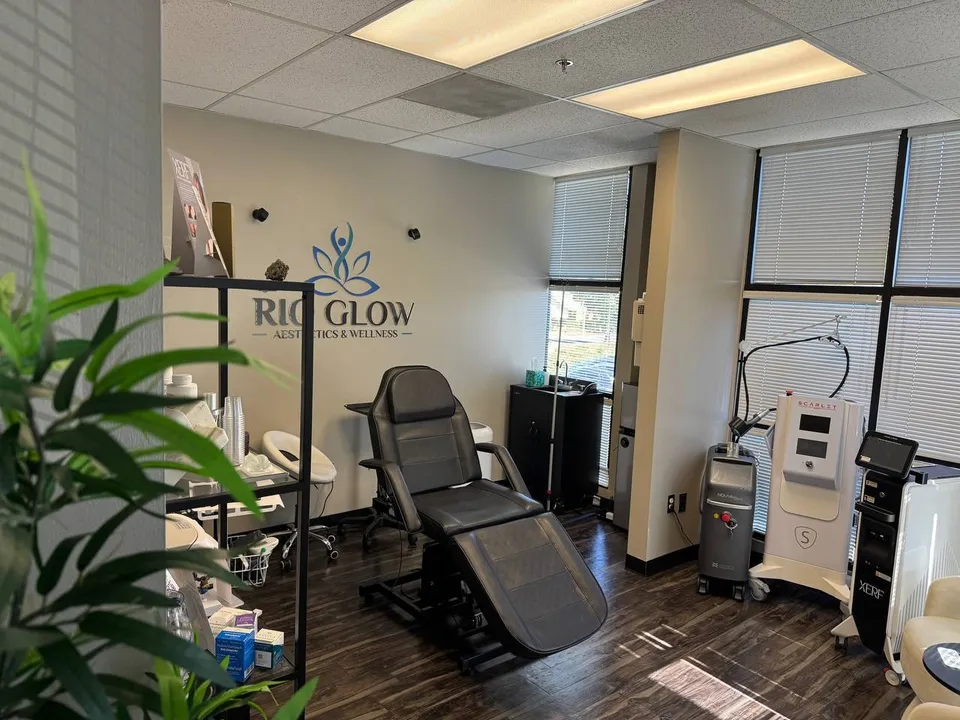
Three machines live at Rio Glow. One fires light at 1927 nanometres. One does not use light at all — it uses radio waves through twenty-five needles. One uses no energy whatsoever. They are not competing products, and knowing the difference is the difference between spending well and spending twice.
"Laser" is not one thing.
It is a category, the way "car" is a category.
When somebody says they had a laser, that sentence carries almost no information. Was it removing the top layer of skin or heating underneath it without touching the surface? Was it going after brown pigment, or red vessels, or water? Was there a needle involved at all? These are wildly different procedures with wildly different recoveries, and they get sold under the same word.
The one idea that makes all of it make sense
Every energy device works by picking a target and heating it faster than the tissue around it can cool down. Change the target and you change the entire treatment. That is it. That is the whole field.
The rest of this guide is about what each machine at Rio Glow targets, how deep it reaches, what your week looks like afterwards, and how the right one is chosen for you — including the times the answer is "neither, yet".
The rest of the guide is free.
Twelve pages with diagrams: the physics of 1927 nm, why non-insulated needles behave differently, the depth chart, the honest recovery timeline, and who should not have any of it.
Open the guideChapter one
How light chooses a target.
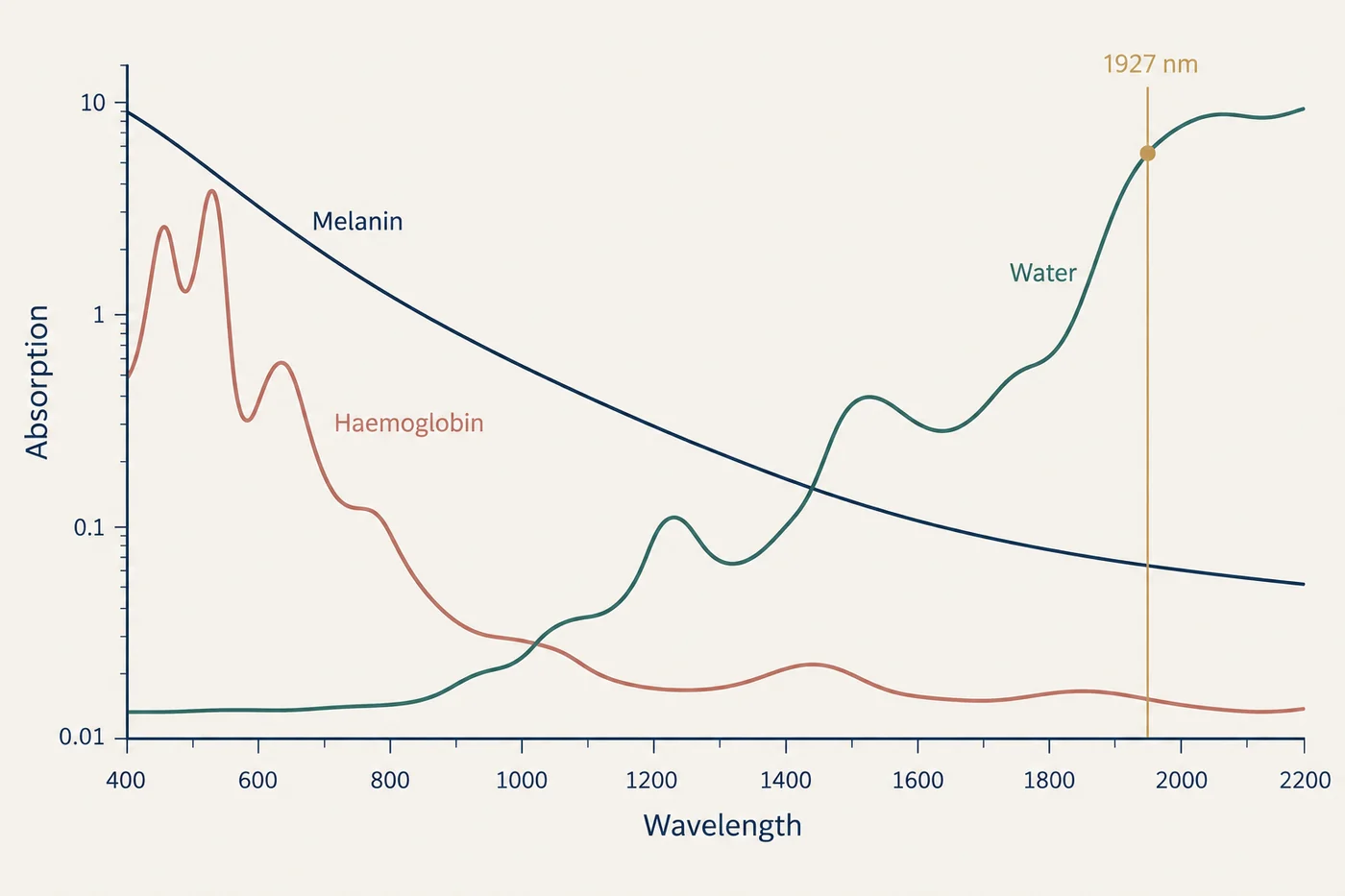
Skin is not one material. It is water, and pigment, and blood, and protein, all layered together. Each of those absorbs light differently depending on the wavelength — and a laser is simply light of exactly one wavelength, which is what makes it a tool instead of a lamp.
Pick a wavelength that pigment loves, and the energy dumps into brown spots. Pick one that haemoglobin loves, and it dumps into blood vessels. Pick one that water loves, and it dumps into everything — because skin is mostly water — and it dumps into it fast and shallow.
Why 1927 is a specific choice, not a marketing number
1927 nm sits in a band that water absorbs strongly. Strong absorption means the energy is used up quickly — so it stays shallow, concentrating in the epidermis and the top of the dermis. That is exactly where sun damage, uneven tone, melasma-type pigment and dull texture live. A deeper wavelength would sail straight past the problem.
Chapter two · the machine that uses light
NouvaDerm, and NouvaGlo mode.
The NouvaDerm is a 1927 nm thulium laser. What makes it unusual is that the same device can run non-ablatively, sub-ablatively and ablatively — three quite different intensities of the same idea.
Non-ablative
The surface stays intact. Heat travels through it and stimulates underneath. Least downtime, gentlest result, most repeatable.
Sub-ablative
The middle setting. Enough energy to disrupt the top layer meaningfully without fully removing it.
Ablative
The top layer is removed in controlled columns. The strongest result and the most real recovery. Reserved, not routine.
NouvaGlo is a mode on that device rather than a separate machine — a set of signature settings aimed squarely at overall revitalisation: brightening, evening out tone, and making skin behave like skin that gets slept on properly. It is the one people mean when they say they want to "look less tired" without being able to point at a specific line.
What the week afterwards is honestly like
Warm, pink, tight.
Like a sunburn that is not sore. Most people go back to work with makeup off and nobody says anything.
Bronzing.
The pigment you came in for gets darker before it leaves. This is the part nobody warns people about and it is completely normal — the damaged pigment is being pushed to the surface.
The sandpaper week.
Texture, fine flaking, that coffee-grounds look. Do not pick it, do not scrub it, do not "help" it. It falls off on its own and it takes the pigment with it.
The part you paid for.
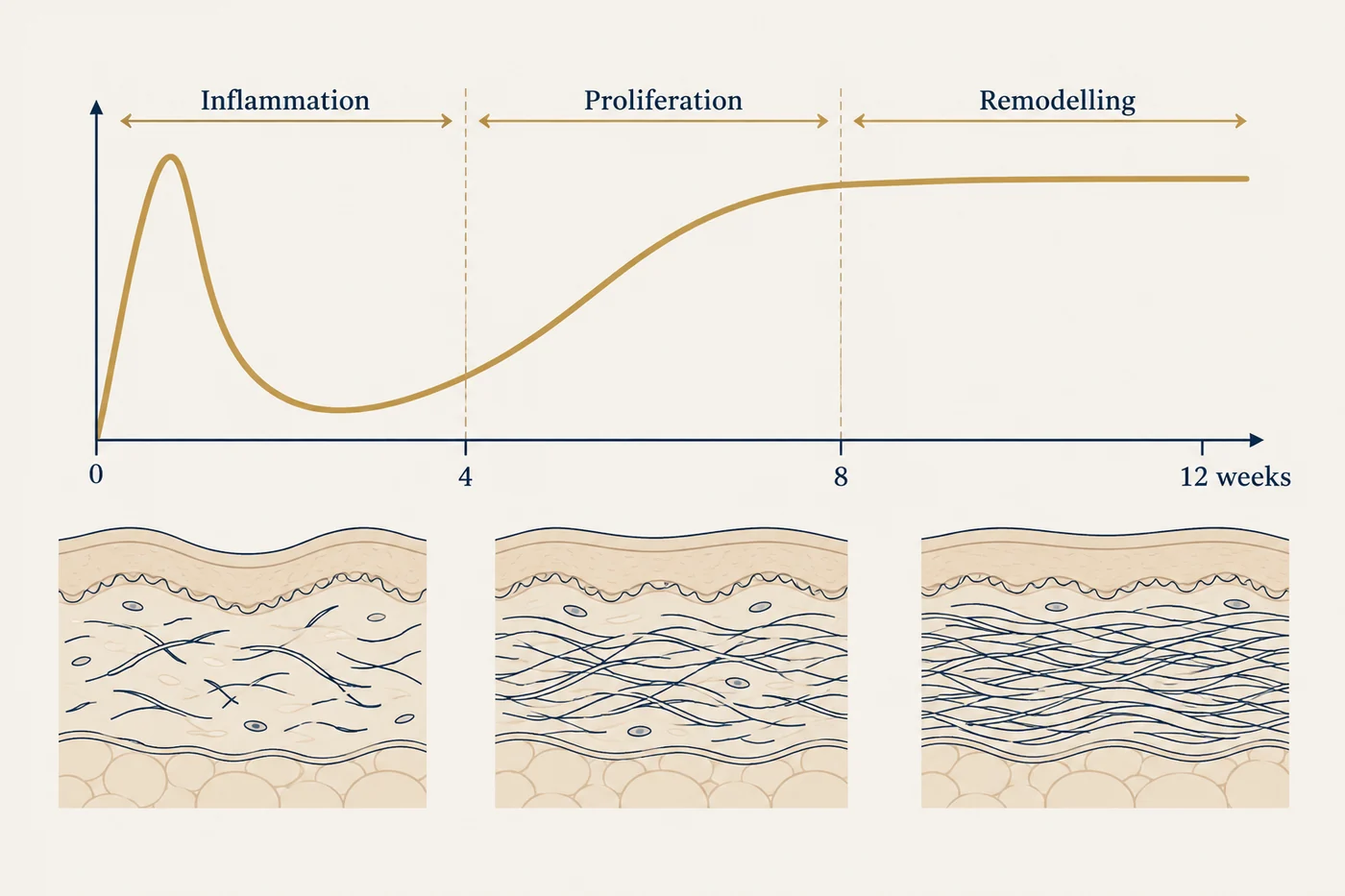
Clear, even, reflective. And then it keeps improving quietly for weeks as collagen catches up.
The two products in the room
Aftercare products are chosen for freshly treated skin, which is briefly more sensitive than intact skin.
Chapter three · the machine that does not use light
Scarlet RF, and why the needles are bare.
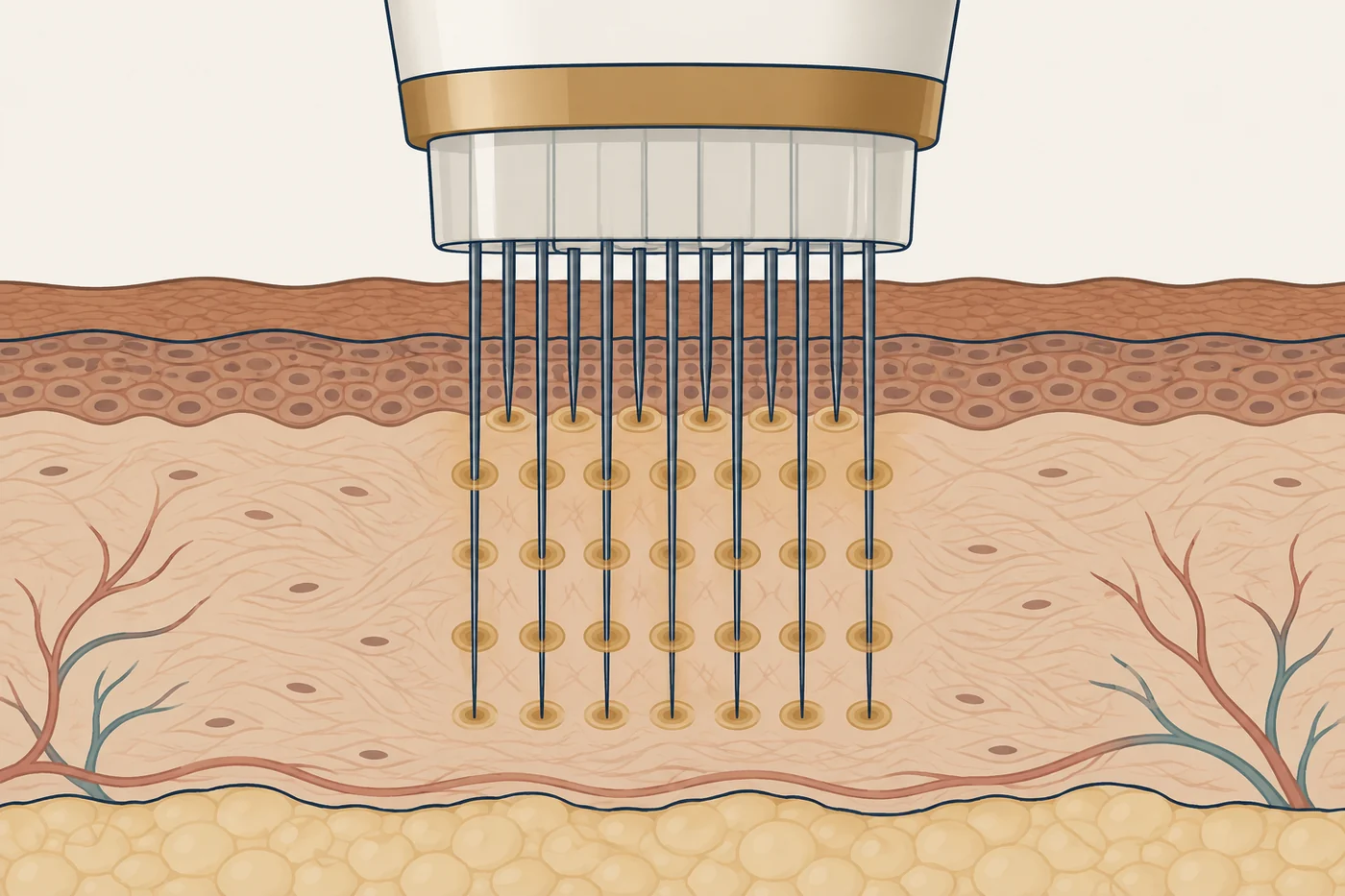
Scarlet SRF is not a laser. It is radiofrequency — energy delivered as an alternating current at roughly 2 MHz — and it gets that energy past the surface by driving twenty-five microneedles into the skin and releasing it from the tips.
That difference matters more than it sounds. A laser has to get through the epidermis to reach the dermis, which means the epidermis takes a hit on the way. Radiofrequency through needles starts in the dermis. The surface is punctured, not cooked. Which is why recovery is a day or two of redness rather than a week of flaking.
Non-insulated needles — the design decision that defines the device
Many RF microneedling systems insulate the shaft of the needle so energy only leaves the very tip. Scarlet's needles are not insulated. Energy leaves along the electrode, producing an independent coagulation zone around each of the twenty-five needles rather than one broad heated plane. You end up with a field of small, precise thermal injuries with healthy untreated tissue between them — which is exactly the arrangement skin repairs from quickly and predictably.
Depth is the dial that changes the treatment
The needle depth is adjustable from 0.5 mm to 3.5 mm in tenth-of-a-millimetre steps. That is not a specification for its own sake — a tenth of a millimetre is the difference between treating acne scarring and treating jawline laxity, on the same face, in the same session.
Ranges shown are how depth is used in practice. Your settings are chosen for your skin on the day, and a single session usually moves through several of these bands across different zones of the face.
Chapter four · the machine with no energy at all
SkinPen, and the case for doing less.
SkinPen is purely mechanical. No light, no radiofrequency, no heat. A sterile cartridge of fine needles creates thousands of controlled micro-channels, and the entire result comes from your body's response to being injured in a very organised way.
That sounds primitive next to a thulium laser. It is not — it is a different risk profile. No heat means no thermal risk to pigment, which matters a great deal for deeper skin tones, and it means the treatment can be repeated on a shorter cycle. It is often the right first step for someone who has never had anything done, or the right maintenance between bigger sessions.
The honest limit
Mechanical microneedling alone will not tighten meaningful laxity and will not clear deep pigment. If somebody promises you it will, they are selling. It is excellent at texture, pores, early lines and overall skin quality — and it is the safest entry point on this list.
Side by side
The comparison, without the marketing.
| NouvaDerm 1927 nm | Scarlet RF | SkinPen | |
|---|---|---|---|
| What it is | Thulium laser — light | Radiofrequency through needles | Needles only, no energy |
| What it targets | Water in the epidermis and upper dermis | The dermis directly, at a chosen depth | The dermis, mechanically |
| Best for | Tone, brown pigment, sun damage, dullness | Texture, pores, acne scarring, early laxity | Texture, pores, overall skin quality |
| Weakest at | Tightening laxity | Surface pigment | Laxity and deep pigment |
| Visible downtime | 5–7 days of texture and flaking | 1–2 days of redness and swelling | 24–48 hours of flushing |
| Sessions | Often a short series, spaced weeks apart | Typically three, spaced roughly a month | Three to six, spaced roughly a month |
| When you see it | Week two, improving for weeks after | Builds over about three months | Builds over about three months |
Chapter five
Why Tathiana combines them.
The two devices are strong in exactly the places the other is weak. The laser is a pigment and tone instrument that does not tighten. Scarlet is a structural instrument that does not do much for surface pigment. Run one and you fix half the complaint.
This is why laser packages at Rio Glow are frequently a Scarlet series with a NouvaDerm session added on to the same course — sequenced so the skin is never being asked to recover from two things at once, and priced as a package rather than two full treatments. Somebody who books both separately, months apart, spends more and gets less, because the two results never overlap in time.
Chapter six
Who should wait, and who should not have it.
A guide that only tells you who a treatment is good for is an advert. Here is the other half.
- If you are pregnant or breastfeeding — these all wait. No exceptions, no clever workarounds.
- If you have an active breakout, cold sore or any infection in the area — it waits until the skin is calm. Energy over an active herpes outbreak can spread it.
- If you have been on isotretinoin recently — tell Tathiana. There is a required gap and it is not negotiable.
- If you are actively tanned or just back from somewhere sunny — a tan is pigment sitting where the laser is about to deliver energy. Reschedule; do not push through it.
- If you keloid or scar unusually — this needs a real conversation before anything is booked.
- If you cannot commit to sun protection for the following weeks — genuinely, wait for a different season. Freshly treated skin that gets sun will pigment, and you will have paid to make the problem worse.
The single best thing you can do for your result
Sunscreen, every day, for the six weeks afterwards. Not because it is a nice habit — because the entire mechanism of every treatment in this guide is controlled injury followed by repair, and ultraviolet light interferes with the repair half.
Want it as a PDF?
Ask for a copy at your consultation.
Still not sure which one is yours?
The quiz asks about your skin, your tolerance for a rough week, and your calendar — then points at one machine and tells you why.
Your glow up starts with a conversation
New clients start with a free 45-minute consultation with Tathiana.