
How do peptides work in skincare to transform your complexion from tired to timeless? These powerful “messenger” molecules act as biological keys, unlocking your skin’s natural ability to repair, firm, and rejuvenate itself. At Rio Glow Wellness and Aesthetics, we believe that understanding the science of peptides is the first step toward achieving the radiant, healthy skin you deserve.
What Exactly Are Peptides?
To understand peptides, you first need to understand the structure of your skin. Think of your skin as a complex building. Proteins like collagen and elastin are the steel beams that keep the structure firm and upright.
The Building Blocks: Amino Acids and Proteins
Peptides are short chains of amino acids. Amino acids are the fundamental “bricks” of life. When these bricks link together in short strings, they form peptides. When those strings become very long and complex, they become proteins.
Peptides vs. Proteins: Why Size Matters for Absorption
You might wonder why we don’t just apply collagen directly to the skin. The answer is size. Collagen molecules are actually too large to penetrate the skin’s outer surface. Peptides, however, are much smaller. Their tiny size allows them to sink deeper into the dermis, where they can actually get to work instead of just sitting on top of your face.
Natural vs. Synthetic Peptides in Modern Science
While our bodies naturally produce peptides, their production slows down as we age. This leads to sagging and wrinkles. In modern skincare, scientists have developed synthetic peptides that mimic our body’s natural signals. These lab-created versions are often more stable and targeted, allowing us to “program” the skin to perform specific tasks, like fading a dark spot or relaxing a deep line.
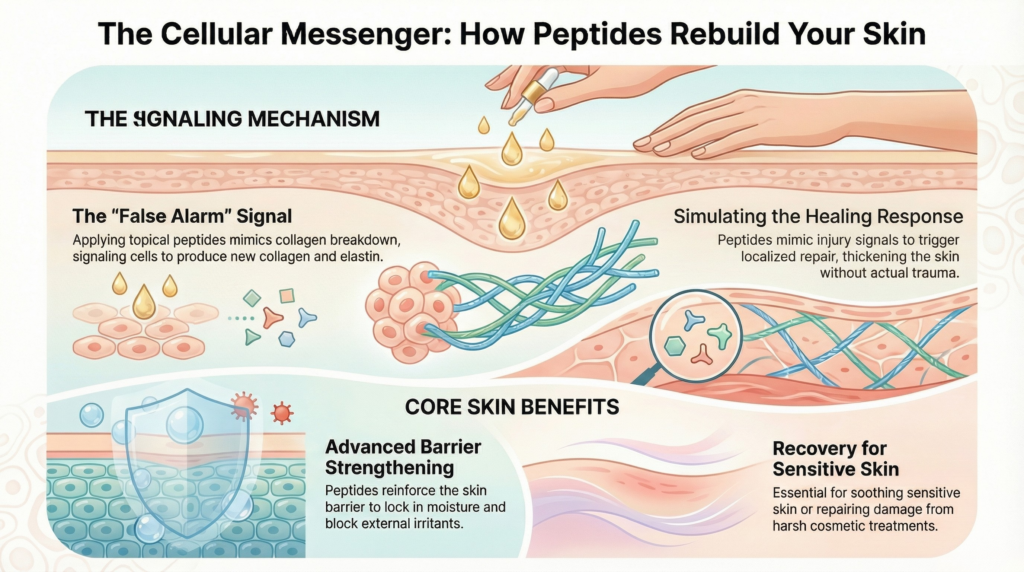
The Mechanism: How Peptides “Talk” to Your Skin
The most fascinating part of peptide science is how they communicate. They aren’t just “food” for your skin; they are messengers.
The Messenger Effect: Signaling Your Cells to Repair
When collagen breaks down—due to age, sun damage, or environmental stress—it creates tiny peptide fragments. When your skin cells “see” these fragments, it acts as an alarm. The cells think, “We are losing collagen! We need to make more!” By applying topical peptides, you are essentially sending a “false alarm” that tells your skin to start building new collagen and elastin immediately.
Tricking the Skin: The Wound-Healing Response
Some peptides work by mimicking the signals sent during an injury. This triggers a localized healing response. Your skin begins to thicken and repair itself, leading to a smoother, more resilient texture without you actually having to sustain an injury.
Improving the Skin Barrier and Resilience
Beyond just anti-aging, peptides strengthen the skin barrier. A strong barrier keeps moisture in and keeps irritants out. This is why peptides are often recommended for people with sensitive skin or those recovering from harsh treatments.
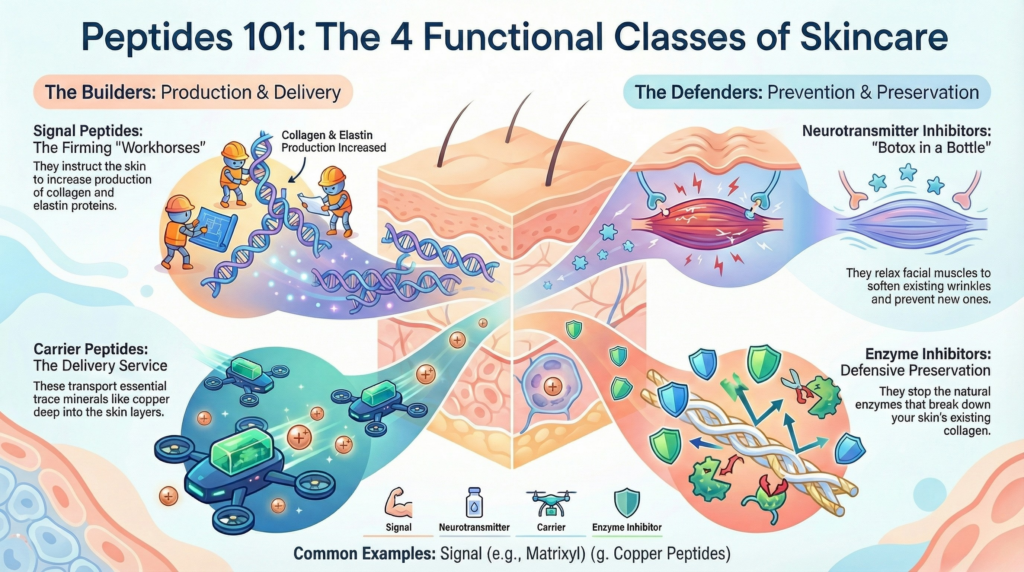
Beyond the Basics: The 4 Main Types of Peptides
Not all peptides are created equal. Depending on their structure, they perform very different roles in your beauty routine.
1. Signal Peptides (e.g., Matrixyl)
These are the most common type found in anti-aging serums. Their primary job is to tell the skin to produce more collagen, elastin, and other structural proteins. They are the “workhorses” of firming skincare.
2. Neurotransmitter Inhibitors (e.g., Argireline)
Often called “Botox in a bottle,” these peptides interfere with the chemicals that cause muscles to contract. By slightly relaxing the facial expressions that lead to crow’s feet and forehead lines, they help prevent new wrinkles from forming while softening existing ones.
3. Carrier Peptides (e.g., Copper Peptides)
These act like a delivery service. They carry trace minerals, like copper, deep into the skin. Copper is essential for wound healing and enzymatic processes that keep the skin looking vibrant and healthy.
4. Enzyme Inhibitor Peptides
These peptides play defense. They stop the enzymes that naturally break down collagen as we age. By preserving the collagen you already have, these peptides help maintain skin thickness and “bounce” over time.
The Key Benefits of Peptides for Your Glow
Integrating peptides into your routine offers a variety of visible improvements:
- Reducing Fine Lines: By boosting collagen, peptides fill in the “divots” that create wrinkles.
- Increasing Firmness: Better elastin production means skin that snaps back into place.
- Calming Inflammation: Many peptides have antioxidant properties that soothe redness.
- Clearing Breakouts: Certain antimicrobial peptides help strengthen the skin’s defense against acne-causing bacteria.
Professional Synergy: Peptides + In-Office Treatments
At Rio Glow Wellness and Aesthetics, we don’t just stop at topical creams. We use the science of peptides to enhance the results of our professional clinical treatments.
Why We Use Peptides After SkinPen® Microneedling
SkinPen® Microneedling creates thousands of tiny, controlled “micro-channels” in the skin. This is the perfect time to apply peptides. Because the skin’s barrier is temporarily open, the peptides can travel deeper than they ever could on their own, dramatically speeding up the healing process and magnifying the collagen-boosting effects.
Peptides and PRP: Accelerating the Natural Healing Process
Platelet-Rich Plasma (PRP) therapy uses your body’s own growth factors to heal the skin. When we combine PRP with peptide-rich aftercare, we are giving your skin a double dose of “repair signals.” This results in faster recovery and a more dramatic “glow.”
How to Layer Peptides Like a Pro
To get the most out of your products, you need to know how to use them correctly.
The “Consistency Rule”: Serums vs. Moisturizers
Peptides work best when they stay in contact with your skin. For this reason, peptide serums are usually more effective than cleansers, which are washed off too quickly to send their “messages.”
Dangerous Duos: Why You Shouldn’t Mix Peptides with AHAs/BHAs
This is a common mistake. Peptides are held together by chemical bonds that can be broken by high acidity. If you apply a strong Alpha Hydroxy Acid (like Glycolic) or Salicylic Acid at the same time as your peptide serum, the acid can “de-nature” the peptide, making it useless. Rio Glow Tip: Use your acids in the evening and your peptides in the morning, or wait at least 30 minutes between applications.
How to Read a Label: Identifying Peptides
Skincare labels can be confusing. To find peptides, look for words ending in “-peptide” or starting with “Palmitoyl.” Common effective ingredients include:
- Palmitoyl Pentapeptide-4
- Acetyl Hexapeptide-8
- Copper Tripeptide-1
At Rio Glow, we recommend medical-grade formulations. Unlike drugstore options, medical-grade products are tested for stability, ensuring the peptides don’t break down before they even reach your skin.
Managing Expectations: How Long Until You See Results?
Peptides are not an overnight fix. While a hydrating mask might make you look better instantly, the structural changes peptides trigger take time. It typically takes 4 to 12 weeks of consistent use to see a visible change in skin firmness and wrinkle depth. Patience is key to achieving a lasting Rio Glow.
Experience the Rio Glow: Personalized Peptide Protocols
Every face is unique. What works for a friend might not be the right “signal” for your skin. At Rio Glow Wellness and Aesthetics, our licensed professionals perform a deep skin analysis to determine exactly what your barrier needs. Whether you are looking for preventative care or deep rejuvenation, we create a custom plan that blends science with luxury.
People Also Ask (FAQ)
1. Can I use peptides with Retinol? Yes! In fact, they work great together. Retinol speeds up cell turnover, while peptides provide the building blocks to create those new cells. Just be careful if you have sensitive skin, as both are active ingredients.
2. Are peptides better than Vitamin C? They aren’t better; they just do different things. Vitamin C is an antioxidant that protects and brightens, while peptides focus on structural repair. For the best results, use both!
3. Do peptides have side effects? Peptides are generally very safe because they mimic substances already found in your body. However, some people may experience minor irritation if the product contains other harsh ingredients.
4. Can peptides replace Botox? While certain peptides (like Argireline) can relax fine lines, they cannot match the strength of an injectable neurotoxin like Botox or Dysport. They are, however, excellent for maintaining your Botox results for longer.
5. Should I use peptides in the morning or night? You can use them both times! Since they don’t make your skin sensitive to the sun (unlike Retinol), they are a perfect addition to your morning routine under your SPF.
Ready to Rediscover Your Glow?
Don’t guess when it comes to your skin’s health. Let the experts at Rio Glow Wellness and Aesthetics help you navigate the science of beauty. Whether you’re interested in medical-grade skincare or advanced treatments like microneedling, we are here to guide your journey.
[Contact Rio Glow Wellness and Aesthetics today to book your personalized skin consultation!]
![[Contact Rio Glow Wellness and Aesthetics today to book your personalized skin consultation!]](https://rioglowaesthetics.com/wp-content/uploads/2026/01/contact.png)