
Reaching your goal weight through a customized weight loss program is a monumental achievement, but many patients wonder what happens if you stop taking semaglutide after reaching your goal weight. Managing your long-term health requires a clear understanding of how your body transitions off GLP-1 medications. The medical team at Rio Glow Aesthetics & Wellness in Rancho Cucamonga is dedicated to helping you navigate this phase safely while protecting your hard-earned progress.
Understanding the Reality of Stopping Semaglutide
Semaglutide has revolutionized chronic weight management by working closely with your body’s natural chemistry. To understand what happens when you stop, it helps to look at the underlying science of how these medications interact with your metabolism.
How Semaglutide Works for Weight Loss (GLP-1 Mechanics)
Semaglutide belongs to a class of medications known as GLP-1 (glucagon-like peptide-1) receptor agonists. It mimics a natural hormone your gut releases after eating. This hormone performs several key tasks:
- Signals the Brain: It targets the areas of the brain that regulate appetite and food intake.
- Slows Digestion: It delays gastric emptying, meaning food stays in your stomach longer to keep you feeling full.
- Regulates Insulin: It prompts your pancreas to release the right amount of insulin when blood sugar levels rise.
The Chronic Disease Model: Why Maintenance Differs from Active Weight Loss
Obesity and chronic weight gain are increasingly recognized by the medical community as complex, long-term health conditions rather than simple failures of willpower. When you are actively losing weight, the medication provides a robust chemical assist.
However, once you achieve your target weight, your body enters a maintenance phase. Without a strategic plan, removing the chemical support of the medication allows old metabolic patterns to resurface.
The Biological “Set Point” and Appetite Regulation
Your body naturally defends its highest sustained weight, a concept known as the biological “set point.” When you lose weight rapidly, your biology interprets this drop as a period of scarcity.
In response, your metabolism tries to conserve energy, and your hunger hormones increase to drive you back toward your previous weight. Stopping semaglutide abruptly exposes your system to these strong survival signals before your body has time to establish a new, lower set point.
The Immediate Effects: What Happens to Your Body Off Injections?
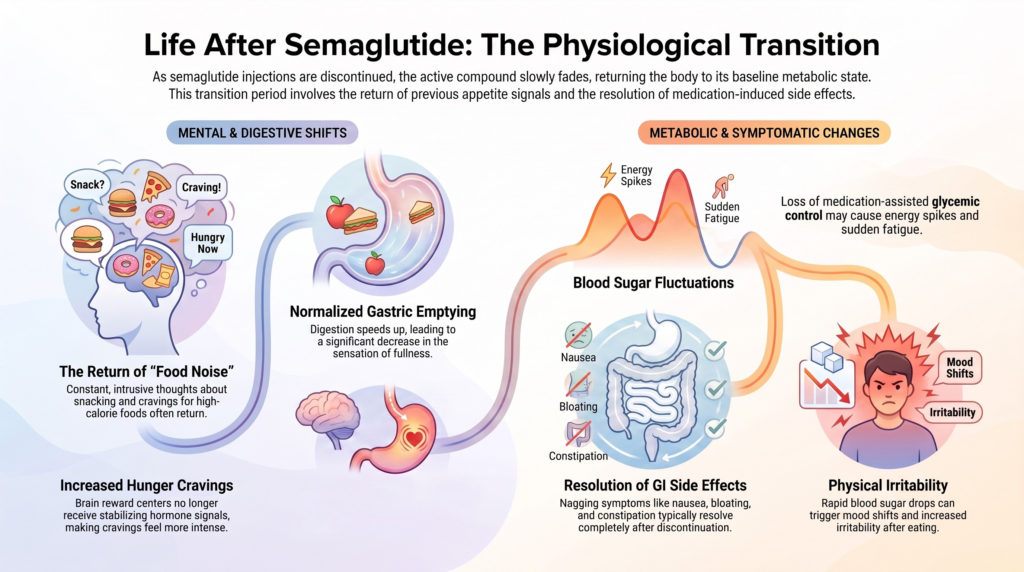
When you discontinue your weekly semaglutide injections, the active compound slowly leaves your system over several weeks. As the medication fades, you will notice distinct changes in your physical sensations and digestion.
The Return of “Food Noise” and Cravings
One of the most profound benefits patients report while taking semaglutide is the elimination of “food noise”—the constant, intrusive thoughts about food, snacking, and the next meal.
When you stop taking the medication, this mental chatter frequently returns. Cravings for high-calorie, sugary, or fatty foods can feel more intense than they did before because your brain’s reward centers are no longer receiving the stabilizing signals of the GLP-1 hormone.
Metabolic Changes: Gastric Emptying and Digestion Speed
Without the medication, your gastric emptying rate returns to its baseline speed. Food will begin to move through your stomach and digestive tract much faster.
As a result, the prolonged sensation of fullness you experienced during treatment will decrease. You may find that you feel genuinely hungry again just a few hours after eating a balanced meal.
Insulin Sensitivity and Blood Sugar Fluctuations
Semaglutide plays a major role in managing glycemic control. When you stop the medication, your body loses that direct assistance in regulating blood sugar.
If your diet shifts back to simple carbohydrates and sugars, you may experience rapid spikes and drops in blood sugar. These fluctuations can trigger sudden fatigue, irritability, and increased hunger.
The Return and Cessation of Gastrointestinal Side Effects
On the positive side, if you struggled with nagging side effects like mild nausea, constipation, or bloating throughout your treatment, these symptoms typically resolve completely once the medication clears your body.
However, if you choose to restart the medication later without a proper titration schedule, those identical gastrointestinal side effects can return.
The “Ozempic Rebound”: What the Clinical Data Shows About Weight Regain
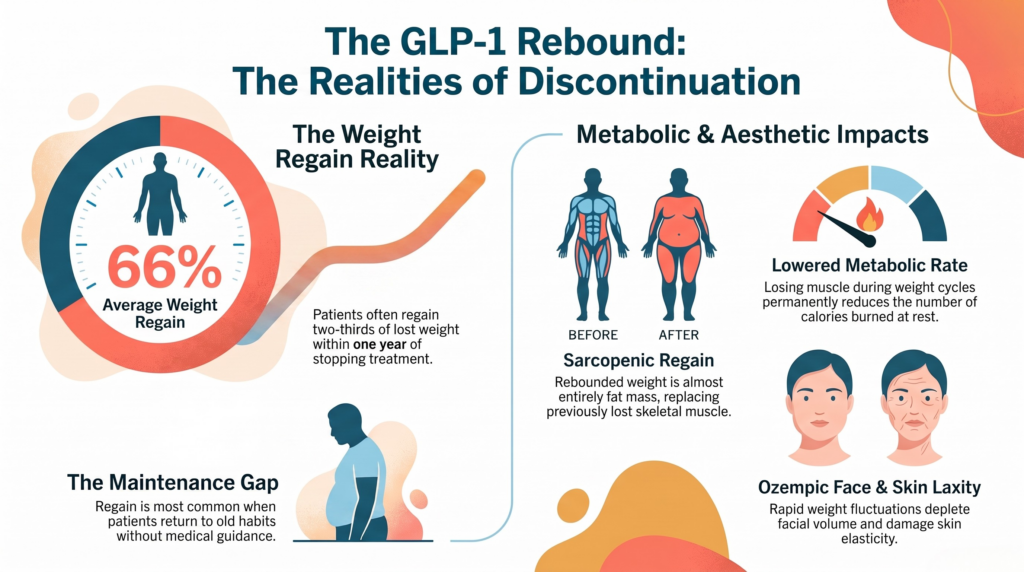
Understanding the statistical realities of stopping GLP-1 therapies allows you to prepare an effective defense strategy rather than being caught off guard.
Average Trajectory: The 1-Year Regain Statistics
Large-scale clinical research, such as the STEP-4 and SURMOUNT clinical trials, tracked patients who stopped taking GLP-1 medications after substantial weight loss. The data consistently demonstrates that a majority of patients regain a portion of their lost weight within the first year of discontinuation if no secondary maintenance plan is established. On average, patients can regain up to two-thirds of the weight they lost if they return to old habits without medical guidance.
The Danger of “Sarcopenic Regain”
When people lose weight quickly on semaglutide, they often lose a combination of fat mass and skeletal muscle mass. If you stop the medication and experience a rapid weight rebound, the weight you put back on is almost entirely fat mass.
This creates a condition known as “sarcopenic regain,” leaving you with a higher body fat percentage and less muscle than you had before you started. Because muscle burns more calories at rest than fat, losing muscle permanently lowers your resting metabolic rate.
Aesthetic Consequences: Facial Volume Loss and Skin Laxity
Rapid weight fluctuations take a visible toll on your appearance. Losing significant weight can result in a depleted facial volume (sometimes called “Ozempic face”) and loose skin around the abdomen, arms, and thighs.
If you experience rapid weight cycles—losing weight, stopping the medication, and regaining fat—the skin can lose its natural elasticity, leading to premature aging and structural sagging.
Medically Supervised Transition Protocols at Rio Glow Aesthetics & Wellness
You do not have to choose between taking a weekly injection forever or risking immediate weight regain. The practitioners at Rio Glow Aesthetics & Wellness offer comprehensive transition protocols tailored to your unique biology.
[ Active Weight Loss Phase ] ──> [ Gradual Tapering / Spacing Doses ] ──> [ Cellular & Aesthetic Maintenance ]
      (High Dose GLP-1)                  (Step-Down Protocol)                 (NAD+, IV Therapy, Body Sculpting)
Cold Turkey vs. Gradual Tapering (Dose Spacing Strategies)
Stopping semaglutide “cold turkey” causes a sharp drop in hormone levels that can overwhelm your regulatory systems. A safer approach involves a gradual taper. Your provider may slowly decrease your weekly dosage or extend the time between injections from every 7 days to every 10 or 14 days. This gives your digestive system and brain chemistry time to adapt to lower levels of the medication.
Transitioning to Low-Dose Tirzepatide for Maintenance Stability
For some patients, maintaining a goal weight is easier when switching to a different compound. Tirzepatide utilizes dual hormone action (targeting both GLP-1 and GIP receptors).
Transitioning to a customized, low-maintenance dose of tirzepatide under the supervision of Rio Glow Aesthetics & Wellness can provide superior appetite control with fewer side effects, making it a highly effective tool for long-term weight stabilization.
Setting the “Red Flag” Threshold: When to Restart Medication
A crucial part of a medical transition plan is establishing clear boundaries. During your consultations at Rio Glow Aesthetics & Wellness, your provider will help you set a “red flag” weight threshold—typically 3 to 5 pounds over your goal weight. If your weight hits this threshold despite lifestyle consistency, it serves as an objective marker to re-evaluate your strategy or temporarily restart a low-dose maintenance protocol before significant regain occurs.
The Lifestyle Architecture for Permanent Weight Maintenance
Securing your long-term results requires building a sustainable framework of daily habits that support your metabolism naturally.
Nutrition Strategy: Mimicking Fullness with High Protein and High Fiber
To replace the artificial fullness provided by semaglutide, your diet must prioritize foods that trigger your body’s natural satiety signals. Focus on lean proteins (such as chicken, fish, tofu, and eggs) and fiber-rich foods (vegetables, legumes, and whole grains). Protein suppresses hunger hormones effectively, while fiber slows digestion naturally in the gut.
Metabolic Defense: Advanced Strength Training for Muscle Preservation
To combat metabolic slowdown and prevent sarcopenic regain, resistance training is non-negotiable. Engaging in dedicated strength training at least three times a week forces your body to maintain and build lean muscle tissue, keeping your resting metabolism high.
Cellular Optimization: Incorporating NAD+ and IV Drip Therapy for Metabolic Support
Shifting away from a daily medical weight loss compound requires optimal cellular energy. Rio Glow Aesthetics & Wellness provides advanced wellness treatments like NAD+ Therapy and customized IV Drip Therapy.
NAD+ supports mitochondrial function, helping your cells convert food into usable energy efficiently. Regular IV vitamin infusions ensure your body remains fully hydrated and packed with essential micronutrients that optimize metabolic function and fight off post-taper fatigue.
+------------------+-------------------------------------------------------------+
| Wellness Therapy | Core Benefit for Weight Maintenance                         |
+------------------+-------------------------------------------------------------+
| NAD+ Therapy     | Optimizes mitochondrial energy and supports metabolism      |
| IV Drip Therapy  | Delivers direct cellular hydration and essential vitamins  |
+------------------+-------------------------------------------------------------+
Tracking and Accountability: Utilizing Food, Activity, and Emotional Logs
When chemical appetite suppression is removed, mindless eating can easily return. Keeping a daily log of your food choices, physical activity, and stress levels helps you remain mindful of your behavior. It allows you to identify emotional eating triggers before they disrupt your progress.
Sculpting Your Results: Post-Weight Loss Aesthetic Refinement in Rancho Cucamonga
Once your weight has stabilized, you can address the physical changes that significant weight loss leaves behind on your face and body. Rio Glow Aesthetics & Wellness offers an array of advanced aesthetic treatments to refine your look.
- Restoring Lost Facial Volume with Dermal Fillers and Sculptra: Rapid loss of facial fat can cause hollow cheeks and deep lines. Using targeted dermal fillers or Sculptra helps restore youthfulness by stimulating your skin’s natural collagen production.
- Targeting Stubborn Residual Submental Fat with Kybella: Sometimes, even at your goal weight, small pockets of stubborn fat persist under the chin. Kybella injections permanently dissolve these localized fat cells to give you a sharply contoured jawline.
- Tightening Loose Skin Post-Weight Loss with Scarlet RF Microneedling: To improve skin laxity on the face or body, Scarlet RF Microneedling combines radiofrequency energy with microneedling to lift, firm, and remodel deep dermal layers.
Frequently Asked Questions (FAQs)
Can you stop semaglutide for pregnancy or major surgeries?
Yes. You must discontinue semaglutide at least two months before a planned pregnancy, and temporarily pause it prior to any major surgery requiring general anesthesia due to its effect on delayed gastric emptying. Always coordinate this timeline closely with your medical team.
How long does semaglutide stay in your system after the last dose?
Semaglutide has a half-life of approximately one week. This means it takes roughly 4 to 5 weeks after your final injection for the medication to clear out of your system completely.
Will my natural metabolism be permanently damaged after stopping?
No, your metabolism will not be permanently damaged. However, if you lost significant muscle mass during your weight loss journey without doing strength training, your baseline metabolic rate will be lower than it was before.
Is it safe to stop and restart semaglutide multiple times?
While it is physically safe, cycling on and off the medication frequently can make it harder for your body to find a stable metabolic equilibrium. Every time you restart, you must begin at the lowest introductory dose to avoid severe gastrointestinal distress.
Can I switch to Tirzepatide if Semaglutide stops working for me?
Yes. Many patients who experience a weight loss plateau or uncomfortable side effects on semaglutide successfully transition to tirzepatide, which utilizes dual-hormone pathways to optimize appetite control and metabolic efficiency.
Protect Your Progress: Schedule Your GLP-1 Maintenance Consultation
Reaching your goal weight is an incredible milestone, but preserving that success requires an expert, proactive strategy. You do not have to manage the transition alone or live in fear of gaining the weight back. The team at Rio Glow Aesthetics & Wellness provides personalized guidance, advanced metabolic support, and premium aesthetic treatments to ensure you maintain your vibrant results inside and out.
Contact Rio Glow Aesthetics & Wellness today to schedule your comprehensive weight maintenance consultation at our Rancho Cucamonga medical spa.