
If you are trying to decide between Botox vs. Dermal Fillers, you are not alone in wondering which treatment will actually deliver the refreshed, natural look you want. While both options smooth out facial lines and reverse signs of aging, they work in completely different ways behind the scenes. At Rio Glow Aesthetics & Wellness, the medical team helps patients demystify injectables, tailor unit counts to their exact facial anatomy, and eliminate the fear of ever looking “frozen.”
Key Takeaways: The Quick Difference
- Botox relaxes target muscles to smooth “dynamic” wrinkles caused by repetitive facial expressions (like squinting or frowning).
- Dermal Fillers restore lost volume, plumping “static” creases and hollow areas that stay visible even when your face is totally still.
- Unit counts matter: Botox is customized by dose (units), not by syringe size, ensuring precision for every muscle group.
- Many patients need both: Combining Botox for expression lines and fillers for structural volume loss creates a balanced, non-surgical facial refresh.
- Reversibility varies: Hyaluronic acid fillers can be dissolved quickly with an enzyme, while Botox gradually wears off naturally over three to four months.
Botox vs. Dermal Fillers: The Core Difference
Understanding how each treatment operates is the first step toward choosing the right path for your aesthetic goals. While both procedures use delicate injections, they target distinct layers of facial aging.
How Botox Works (Muscle Relaxation for Dynamic Wrinkles) Botox belongs to a class of treatments known as neuromodulators or wrinkle relaxers. When injected into targeted facial muscles, it temporarily blocks the nerve signals that tell those muscles to contract.
When muscle movement softens, the skin sitting directly above it flattens out smoothly. This mechanism eliminates or reduces “dynamic” lines—the wrinkles that form when you laugh, frown, or furrow your brows.
How Dermal Fillers Work (Volume Restoration for Static Wrinkles) Dermal fillers are smooth, gel-based substances injected beneath the skin surface. Instead of relaxing underlying muscles, fillers physically fill empty space to replace lost fat pads, lift sagging tissue, and smooth out deep, “static” folds.
Most modern dermal fillers are made from Hyaluronic Acid (HA), a molecule naturally produced by your body that binds water to keep skin supple and plump.
Direct Comparison: Botox vs. Dermal Fillers
| Feature | Botox (Neuromodulators) | Dermal Fillers |
|---|---|---|
| Primary Action | Relaxes active underlying muscles | Rebuilds lost volume and structural support |
| Best For | Expression lines (crow’s feet, forehead, frown lines) | Deep folds, thin lips, hollow cheeks, weak jawlines |
| Onset of Results | 3 to 14 days (full effect at day 14) | Immediate volume (final result in 2 weeks) |
| Longevity | 3 to 4 months | 6 to 24 months (varies by product and area) |
| Pricing Structure | Measured and priced per Unit | Sold and priced per Syringe |
Primary Uses and Target Areas
- Botox Target Areas: Upper forehead creases, “11s” between the brows (glabella), crow’s feet around the eyes, bunny lines along the nose, and neck bands.
- Filler Target Areas: Cheeks, nasolabial folds (smile lines running from nose to mouth), marionette lines, lips, under-eye hollows (tear troughs), and the jawline.
Onset Speed & Results Longevity Botox requires a little patience. Softening begins within three to five days, with full results visible around day 14. Smooth skin lasts three to four months before muscle action gradually returns.
Dermal fillers offer instant visual results. You will see immediate volume right after your appointment, with the gel settling into its final, natural texture over two weeks. Fillers last anywhere from six months to two full years, depending on the product thickness and how quickly your body metabolizes it.
Average Cost and Syringe vs. Unit Pricing One common point of confusion is how these treatments are measured. Botox is calculated in units, which represent the exact potency needed to relax a specific muscle group. Smaller muscles require fewer units; stronger muscles require more.
Dermal fillers are pre-packaged and sold by the syringe (usually containing 1.0 mL of gel). During a consultation at Rio Glow Aesthetics & Wellness, your provider breaks down exactly how many units or syringes align with your goals so there are no surprises.
Botox vs. Dermal Fillers for Common Facial Concerns
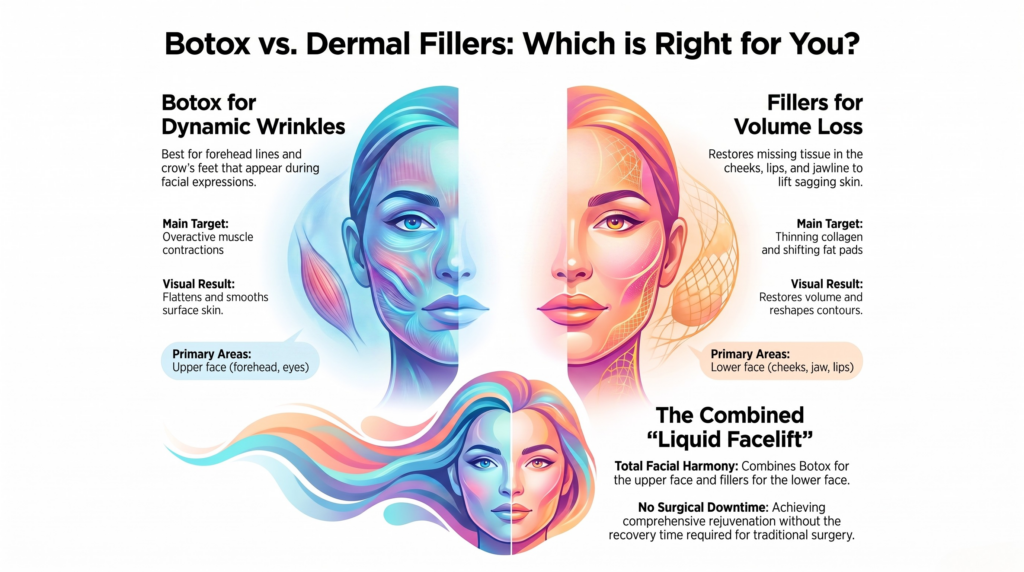
Dynamic Wrinkles (Crow’s Feet, Forehead Lines, Frown Lines) If your forehead lines or eye creases only show up when you make facial expressions, Botox is your best tool. By dampening overactive muscle contractions, the skin flattens back out smoothly.
Facial Volume Loss (Cheeks, Hollow Eyes, Lips, Jawline) As skin ages, natural collagen production slows and facial fat pads shift downward. Botox cannot restore lost tissue or fill sunken cheeks. Dermal fillers restore that missing volume, lifting sagging skin and reshaping facial contours.
Sometimes the Right Answer is Both (The “Liquid Facelift”) Many patients experience both dynamic wrinkles and structural volume loss simultaneously. In these cases, combining Botox for the upper face and fillers for the lower face yields complete facial harmony without surgical downtime.
Dynamic vs. Static Wrinkles: The Self-Test
To help you figure out what your face needs before you even step into a clinic, try this 30-second mirror test:
- Step One: The Rest Test. Relax your entire face completely. Look close in the mirror. Do you see deep creases around your mouth, hollow spots under your eyes, or thin lips even when you aren’t smiling? These are static wrinkles—dermal fillers are your primary solution.
- Step Two: The Expression Test. Now, make exaggerated facial movements. Raise your eyebrows high, frown deeply, and squeeze your eyes shut. Do deep lines suddenly appear across your forehead or around your eyes? These are dynamic wrinkles—Botox is your target treatment.
Alternative Injectable Brands to Know
While “Botox” and “Filler” are household terms, the medical aesthetics world includes several FDA-approved brands tailored to unique patient needs.
Botox Alternatives: Dysport, Xeomin, Jeuveau, and Daxxify
- Dysport: Features a slightly wider spread pattern, making it ideal for treating larger areas like smooth forehead coverage.
- Xeomin: Formulated without complexing proteins (often called the “naked” neurotoxin), which reduces the chance of building up product resistance over time.
- Jeuveau: Engineered specifically for aesthetic performance, designed to target tough frown lines between the brows.
- Daxxify: Utilizes a novel peptide structure to anchor the active ingredient, helping results last up to six months or longer for eligible patients.
Filler Options: Hyaluronic Acid vs. Biostimulators
- Hyaluronic Acid Fillers (Juvéderm, Restylane): Smooth, flexible gels that instantly attract moisture for soft, natural-looking fullness in lips, cheeks, and lines.
- Biostimulatory Injectables (Sculptra, Radiesse): Rather than just adding immediate physical gel volume, these products stimulate your skin’s own fibroblasts to rebuild structural collagen over several months for long-lasting firmness.
Side Effects, Safety, and Reversibility
Potential Side Effects and Recovery Downtime Both Botox and dermal fillers are minimally invasive, non-surgical treatments requiring zero true downtime. Temporary side effects may include mild redness, minor swelling, or small pinpoint bruises at the injection site. Most patients return to work or daily activities immediately.
Can You Dissolve Bad Results? Filler Reversibility vs. Botox Waiting Period Understanding treatment reversibility provides peace of mind before getting started:
- Dermal Fillers (Hyaluronic Acid): HA-based fillers are 100% reversible. If you ever want to adjust your results, an injector can administer an enzyme called hyaluronidase. This enzyme breaks down the hyaluronic acid gel within 24 to 48 hours, returning your tissue to baseline safely.
- Botox: Neuromodulators cannot be reversed with a dissolving enzyme. If too many units are placed or if the product migrates due to improper post-care, you must wait for your body to naturally clear the protein, which takes about 10 to 14 weeks. This makes choosing a skilled, licensed provider essential.
What to Expect During and After Your Treatment

Preparing for Your Consultation & Choosing a Provider At Rio Glow Aesthetics & Wellness, every treatment plan starts with a comprehensive evaluation. Your practitioner analyzes your facial movements, discusses your budget, and explains exact unit doses so you feel confident before any treatment begins.
Pre-Treatment Preparation and Post-Care Rules
- Before Treatment: Avoid blood-thinning supplements and over-the-counter medications (such as aspirin, ibuprofen, fish oil, and vitamin E) for 3 to 5 days prior to reduce your risk of minor bruising.
- After Botox: Remain upright for at least 4 hours after your injections. Do not rub, massage, or apply heavy pressure to treated areas, and skip strenuous exercise for 24 hours so the product stays localized.
- After Filler: Keep the skin clean, avoid harsh facial rubbing, and apply cool compresses gently if you notice light swelling.
Frequently Asked Questions
Which works better for jowls and sagging skin, Botox or filler?
Dermal fillers are typically the first choice for early jowling because placing structural filler in the upper cheeks and along the posterior jawline physically lifts sagging skin. However, precise micro-doses of Botox along the platysma neck muscles (known as a Nefertiti Lift) can also help relax down-pulling muscle bands.
What is the best age to start preventative Botox or fillers?
Many individuals begin “preventative Botox” in their mid-to-late 20s or early 30s to keep repetitive movements from etching permanent lines into the skin. Dermal fillers are introduced whenever natural volume loss becomes noticeable, usually starting in the 30s or 40s.
Are fillers safer than Botox?
Both treatments carry strong safety profiles when performed by licensed medical professionals. Botox has a very low risk profile because it works at the shallow muscle level, while hyaluronic acid fillers offer the safety benefit of being completely reversible if needed.
Can you drink coffee or alcohol after Botox or fillers?
It is best to avoid alcohol for 24 hours before and after your appointment because alcohol thins the blood and increases bruising risks. Moderate coffee consumption is fine, though cutting back on heavy caffeine right before your visit helps keep your blood pressure steady.
How do I avoid looking “frozen” or “overfilled”?
Avoiding a “frozen” or heavy look comes down to conservative dosing and expert anatomic placement. Experienced injectors preserve natural facial expression by delivering precise unit counts tailored to your muscle strength, rather than applying a rigid, one-size-fits-all dosage.
The Bottom Line: Choosing the Right Treatment for You
Whether your goal is to smooth stubborn forehead furrows, restore youthful volume to your cheeks, or gently refresh your entire face, understanding how Botox and fillers work gives you total control over your aesthetic journey. You do not have to guess which option is right for you or worry about unnatural results.
The expert clinical team at Rio Glow Aesthetics & Wellness in Rancho Cucamonga, CA, specializes in conservative, high-precision injectables designed to enhance your natural beauty. Contact Rio Glow Aesthetics & Wellness to reserve your personalized consultation today!