Understanding the difference between infrared and red light therapy comes down to visual light wavelengths, penetration depth, and your specific wellness goals. While both treatments harness natural light to boost cellular health, red light targets surface skin issues while invisible infrared light penetrates deep into muscles and joints. Choosing the right modality—or combining both under medical supervision—is the key to unlocking visible, lasting anti-aging and recovery results.
Understanding Light Therapy (Photobiomodulation)
Light therapy is more than just a passing wellness trend. It is rooted in photobiomodulation (PBM), a science-backed process that uses targeted light spectrums to trigger positive biological shifts inside your body.
What is Photobiomodulation (PBM)?
Photobiomodulation refers to using light energy from light-emitting diodes (LEDs) or lasers to stimulate biological tissue. Rather than using heat or harsh chemicals, PBM delivers light photons directly into your cells. This non-invasive stimulus helps reduce inflammation, speed up recovery, and improve cellular function.
What is Light Wavelength and Why Does It Matter?
Light travels in waves, and the distance between these wave peaks is measured in nanometers (nm). The wavelength dictates:
- Whether the light is visible to the human eye.
- How deep the light energy can travel into human tissue.
Shorter light wavelengths operate near the surface of the body. Longer light wavelengths pass through upper skin layers to reach muscles, fascia, and joints.
How Light Energy Interacts with Mitochondria
Every cell in your body relies on tiny powerhouses called mitochondria to generate energy. Mitochondria contain a specialized light receptor called cytochrome c oxidase.
When targeted light hits this receptor, it stimulates the production of adenosine triphosphate (ATP)—the fundamental energy source your cells use to repair damage, produce collagen, and flush out toxins. Boosting ATP is like recharging a depleted cellular battery.
Red Light Therapy vs. Infrared Therapy: Quick Comparison Overview
While both therapies fuel your mitochondria, their physical properties and primary targets differ significantly:
| Feature | Red Light Therapy | Infrared Light Therapy |
| Visibility | Visible bright red light | Invisible to the naked human eye |
| Wavelength Range | ~620nm to 700nm | ~700nm to 1,000,000nm (1mm) |
| Penetration Depth | Surface skin (1mm to 2mm) | Deep tissue, muscle, bone (up to 5mm+) |
| Primary Target | Epidermis, dermis, collagen | Deep muscles, joints, systemic circulation |
| Thermal Feeling | Cool / non-thermal | Mild warmth to deep sweat (depends on type) |
| Best Used For | Wrinkles, acne, scars, skin tone | Muscle soreness, arthritis, deep joint pain |
What is Red Light Therapy? (Visible Spectrum)
Red light therapy uses precise wavelengths within the visible red spectrum to renew the outer structure of your skin.
       [ VISIBLE RED LIGHT ]              [ INVISIBLE NEAR-INFRARED ]
          (620nm - 700nm)                      (700nm - 1400nm)
                 │                                    │
    ▼                        ▼                    ▼                        ▼
[Epidermis]             [Dermis]            [Subcutaneous]            [Muscles & Joints]
Target Wavelength Range (620nm – 700nm)
The clinical sweet spot for visible red light sits between 630nm and 660nm. These exact wavelengths are readily absorbed by skin tissues without triggering melanin or causing sun damage.
Primary Medical & Aesthetic Applications
Red light therapy works wonders for surface-level rejuvenation:
- Collagen & Elastin Boosting: Smooths fine lines, tightens crow’s feet, and firms sagging skin.
- Wound & Scar Healing: Speeds up cellular repair following aesthetic treatments or minor skin damage.
- Anti-Inflammatory Action: Reduces active acne breakouts, rosacea flare-ups, and skin redness.
Depth of Penetration
Visible red light reaches a depth of approximately 1mm to 2mm. This makes it ideal for the top layers of your skin—the epidermis and dermis—where structural proteins reside.
What is Infrared Light Therapy? (Invisible Spectrum)
Infrared light moves past visible boundaries to deliver cellular energy into deep biological structures.
Breaking Down the Infrared Spectrum
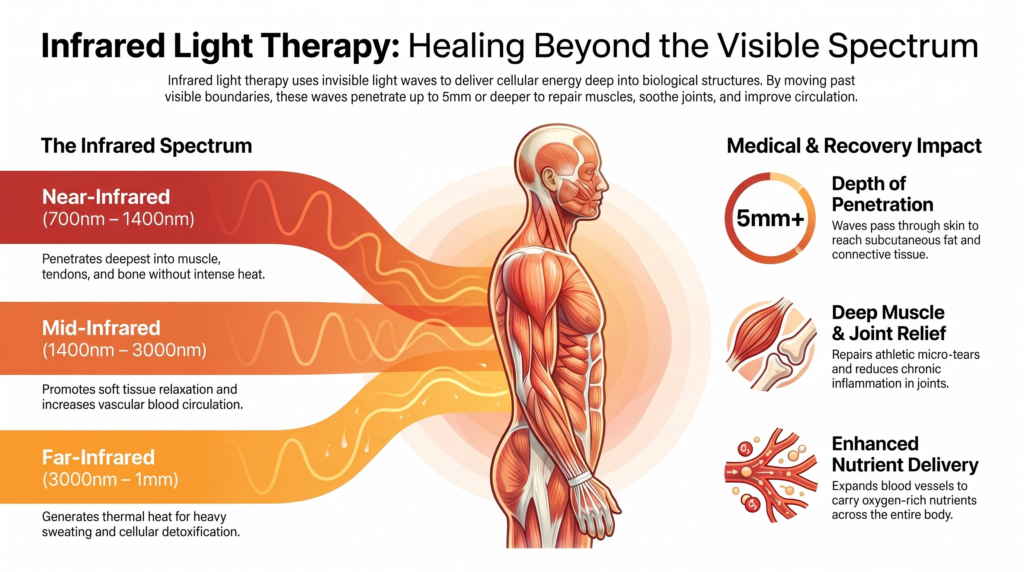
The infrared band is vast and divided into three primary zones:
Near-Infrared (NIR) (700nm – 1400nm): Penetrates deepest into muscle tissue, tendons, and bone without generating intense heat.
Mid-Infrared (MIR) (1400nm – 3000nm): Promotes soft tissue relaxation and increases vascular blood circulation.
Far-Infrared (FIR) (3000nm – 1mm): Generates thermal heat that absorbed by body water, encouraging heavy sweating and detoxification.
Primary Medical & Recovery Applications
- Deep Muscle Recovery: Repairs micro-tears in athletic muscle tissue and reduces post-workout soreness.
- Joint & Arthritis Relief: Soothes chronic inflammation in knees, back, shoulders, and wrists.
- Enhanced Blood Flow: Expands blood vessels to carry oxygen-rich nutrients across the entire body.
Depth of Penetration
Infrared waves pass through upper skin layers to penetrate up to 5mm or deeper, delivering repair signals straight to subcutaneous fat, tight muscles, and sore connective tissue.
Infrared Saunas vs. Red Light Therapy Panels: Clearing Up the Thermal Confusion
A common point of confusion for patients is the difference between an infrared sauna and a targeted LED panel. While both use infrared spectrums, their delivery mechanisms serve entirely different health goals.
+-------------------------------------------------------------------------+
|                          THERMAL vs. NON-THERMAL                        |
+------------------------------------+------------------------------------+
|          INFRARED SAUNA            |           LED LIGHT PANEL          |
|    (Far-Infrared / Heat Energy)    |    (Photons / Photobiomodulation)  |
+------------------------------------+------------------------------------+
| • Uses heat to raise body temp     | • Uses light photons (no heat)     |
| • Triggers heavy sweating          | • Targets cellular mitochondria    |
| • Burns calories via heart rate    | • Repairs tissue at cellular level |
| • Primary: Detox & Relaxation      | • Primary: Anti-Aging & Recovery   |
+------------------------------------+------------------------------------+
Heat Therapy vs. Non-Thermal Photobiomodulation
- Infrared Saunas use heat energy (mainly Far-Infrared) to raise your core body temperature. The main therapeutic driver is heat stress, which triggers cardiovascular activity and heavy sweating.
- LED Light Panels use light energy (red and near-infrared photons) without elevated heat. The benefit comes directly from light absorption within your cells, not thermal sweating.
Which Option Burns Calories vs. Which Repairs Cells?
If your primary goal is cardiovascular conditioning, sweating, and calorie burn, an infrared sauna provides that systemic heat stress.
However, if your goal is fine-line reduction, skin firming, localized joint relief, or post-procedure healing, LED Photobiomodulation delivers target photons without subjecting your skin to thermal strain.
At Rio Glow Aesthetics & Wellness, clinical specialists help you integrate photobiomodulation alongside advanced skin procedures—such as Scarlet RF Microneedling, NouvaDerm Laser Resurfacing, or NAD+ IV Therapy—for maximum cellular revitalization.
The Synergistic Approach: Why Combining Red and Near-Infrared (NIR) Light Works Best
You do not always have to choose between red light and infrared light. The most effective clinical treatments merge both spectrums to treat every skin layer simultaneously.
The Dual-Wavelength Effect
By layering visible red light over near-infrared light, you treat skin from the outside in:
- Red light (e.g., 660nm) rebuilds skin texture, firms tone, and calms surface redness.
- Near-infrared light (e.g., 850nm) dives deeper to soothe inflammation, repair underlying vascular systems, and ease facial tension.
This dual action produces healthier, firmer skin supported by strong, inflammation-free deep tissues.
Treatment Frequency, Dosing, and Safety Standards
To achieve results, light therapy requires proper treatment protocols and consistent execution.
Recommended Session Length and Daily/Weekly Limits
- Session Duration: Most clinical sessions run between 10 to 20 minutes. Leaving light on longer does not yield faster results—cells can only absorb a set amount of energy during a single session.
- Frequency: Starting with 3 to 5 sessions per week for the first month builds cellular momentum. Maintenance treatments can then be scheduled 1 to 2 times weekly.
Understanding Irradiance ($mW/cm^2$) and Energy Density ($J/cm^2$)
Two critical variables dictate whether light therapy actually works:
Irradiance ($mW/cm^2$): The measure of light power output hitting a specific surface area. Weak irradiance yields weak cellular stimulation.
Energy Density ($J/cm^2$): The actual dose of energy delivered over time.
If power output is too low, your tissue never receives enough energy density to trigger ATP production. Clinical-grade systems deliver precise irradiance to ensure every minute of treatment yields real results.
Safety Profile and Minimal Side Effects
Light therapy is non-invasive, drug-free, and pain-free. Side effects are rare but can occasionally include mild, temporary tightness or slight tightness immediately after treatment.
Contraindications: Who Should Exercise Caution?
While safe for almost all skin types (Fitzpatrick I–VI), consult a licensed medical provider before treatment if you:
- Are pregnant.
- Have active cancer lesions.
- Take photosensitizing medications (such as certain acne treatments or antibiotics).
- Suffer from medical conditions triggered by light exposure.
Buyer’s Guide: What to Look for in a Home Light Therapy Device
Many patients try consumer masks or desktop panels before seeking medical-grade options. If you are shopping for an at-home device, keep these key standards in mind:
Key Specs to Check
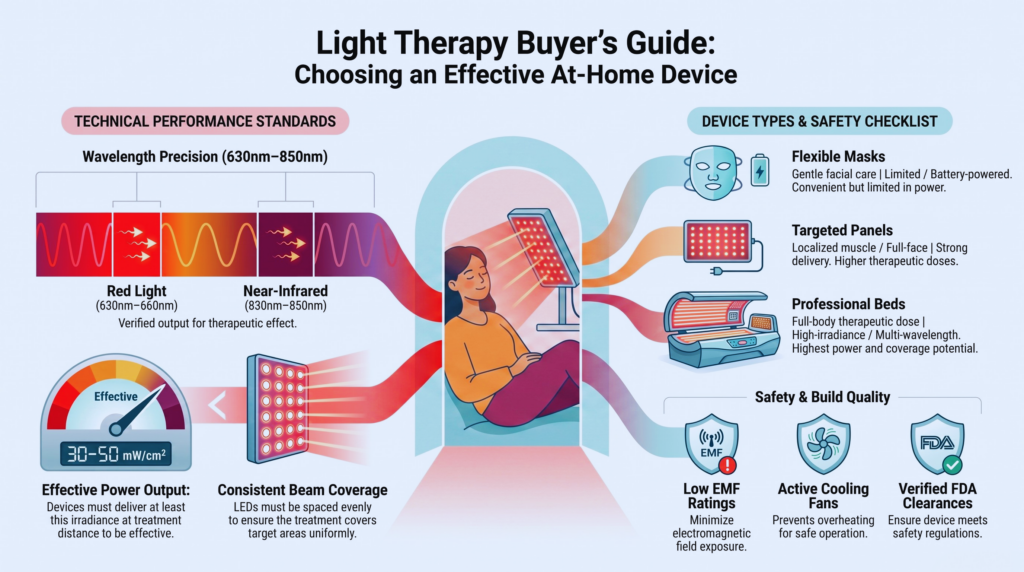
- Wavelength Precision: Ensure the device outputs verified light wavelengths (630nm–660nm for red; 830nm–850nm for near-infrared).
- Sufficient Power Output: Check that power output delivers at least $30\text{–}50\text{ }mW/cm^2$ at treatment distance. Weak novelty masks often fall below effective levels.
- Consistent Beam Coverage: Ensure LEDs are spaced evenly so treatment covers target areas uniformly.
Red Light Masks vs. Portable Panels vs. Full-Body Beds
- Flexible Masks: Convenient for gentle surface facial care, though power output is limited by battery size and slim design.
- Targeted Panels: Great for localized muscle treatment or full-face exposure with stronger light delivery.
- Professional Medical Panels & Beds: Offer high-irradiance, multi-wavelength coverage that delivers true therapeutic doses in less time.
EMF Safety, Heat Dissipation, and FDA Clearances
Always confirm that home equipment carries low EMF (electromagnetic field) ratings to ensure safe usage close to your body. Look for medical-grade build quality, active cooling fans, and clear FDA clearances for device safety.
Why Professional In-Office Treatments Outperform At-Home Devices
While consumer panels offer convenience for mild maintenance, they struggle to match the transformative results of professional medical spa treatments.
+-------------------------------------------------------------------------+
|                  AT-HOME DEVICES vs. IN-OFFICE CARE                     |
+------------------------------------+------------------------------------+
|          AT-HOME PANELS            |    RIO GLOW AESTHETICS CARE        |
+------------------------------------+------------------------------------+
| • Low irradiance (weak output)     | • High-irradiance clinical systems |
| • Long session times needed        | • Targeted 10 to 20 minute sessions|
| • One-size-fits-all approach       | • Custom medical-grade protocols   |
| • Unmonitored, trial-and-error     | • Supervised by licensed pros      |
| • Isolated treatment benefits      | • Combined with IV, Lasers, & PRP  |
+------------------------------------+------------------------------------+
Clinical-Grade Power Output: At-home panels keep energy output low for safety reasons, requiring months of daily use for subtle changes. Professional equipment delivers optimal doses in fraction of the time.
Customized Care Plans: Skin concerns rarely exist in a vacuum. A customized treatment plan combines light therapy with targeted procedures like Botox, PDO Threads, or PRP Therapy to address deep volume loss and surface wrinkles at the same time.
Medical Supervision: Licensed practitioners analyze your skin type, medical history, and aesthetic goals to select the exact light combination your skin needs.
At Rio Glow Aesthetics & Wellness in Rancho Cucamonga, CA, advanced skin therapies are tailored around your unique needs. Whether you want to clear stubborn skin texture, calm post-treatment inflammation, or build an anti-aging plan, professional care delivers visible results safely.
People Also Ask (FAQs)
Can you see infrared light with the human eye?
No, pure infrared light falls outside the visible spectrum of human vision. During near-infrared light treatments, LEDs may look dim or unlit even though they are emitting invisible light energy into your tissue.
Does red light therapy produce UV rays or cause sun damage?
No, red light and near-infrared therapy do not emit harmful ultraviolet (UV) radiation. They do not tan your skin, cause sunburn, or increase the risk of skin cancer.
Can I use red light therapy every day?
Yes, red light therapy is safe for daily use. However, because your cells can only absorb a limited amount of energy per day, 3 to 5 sessions per week generally deliver optimal results without wasting time.
Do I need eye protection during red light or infrared light sessions?
While red and near-infrared light are non-thermal and safe, high-output clinical panels are very bright. Wearing protective eyewear ensures comfort throughout your treatment session.
What is the main difference between red light and near-infrared light?
The primary difference is penetration depth. Red light (630nm–660nm) targets surface skin layers to boost collagen and calm inflammation. Near-infrared light (830nm–850nm) penetrates deep into muscles and joints to reduce inflammation and speed up recovery.
How soon will I see results from light therapy?
Surface skin improvements like reduced redness and increased radiance often appear within 1 to 2 weeks. Structural changes like collagen production, fine line smoothing, and deep tissue recovery usually take 6 to 8 weeks of consistent sessions.
Transform Your Skin and Cellular Health with Rio Glow Aesthetics & Wellness
Understanding light therapy is the first step—putting it to work for your health is where real transformation happens. Stop guessing with underpowered home gadgets and discover what medical-grade care can do for your skin and energy levels.
At Rio Glow Aesthetics & Wellness in Rancho Cucamonga, CA, our board-certified practitioners combine advanced light therapies, laser resurfacing, injectables, and wellness infusions into one cohesive plan designed specifically for you.
Take the shortcut to radiant skin, reduced inflammation, and renewed confidence.
Ready to Restore Your Natural Glow? Contact Rio Glow Aesthetics & Wellness Now!